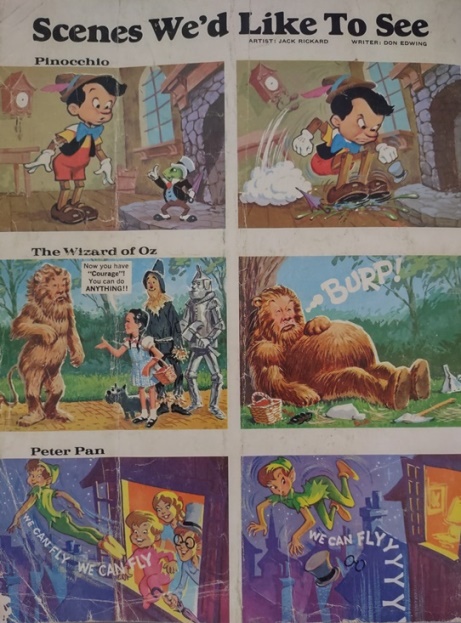
A Mad, Mad World
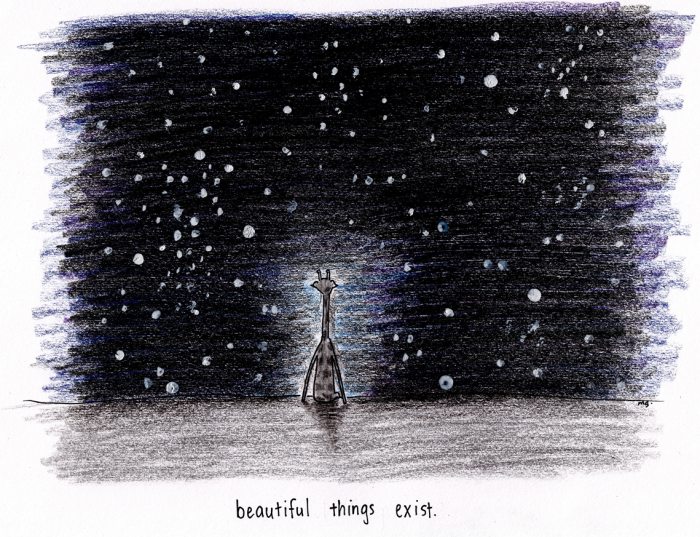
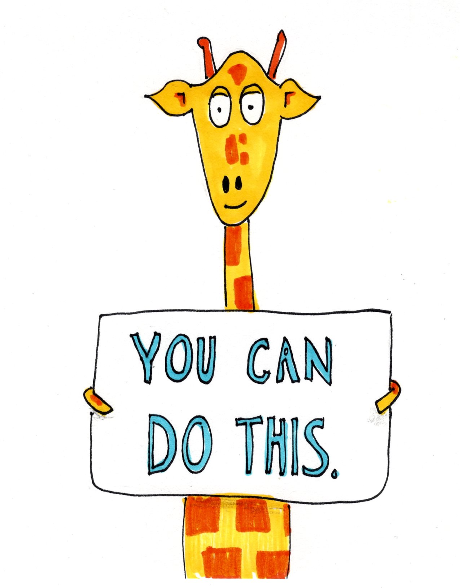
Although fellow WordPresser Penny’s Motivating Giraffe site has been defunct for exactly two years now, I thought today, Palm Sunday, would be a great day to share some of her images I have enjoyed over the years, which seem especially poignant today.



Perusing the pages of ancient yearbooks, I have seen many a Sadie Hawkins dance. But this 1946 event from North Texas State University takes the cake! What an eye for detail these kids had. 
L’il Abner was everywhere.

They really got into character.


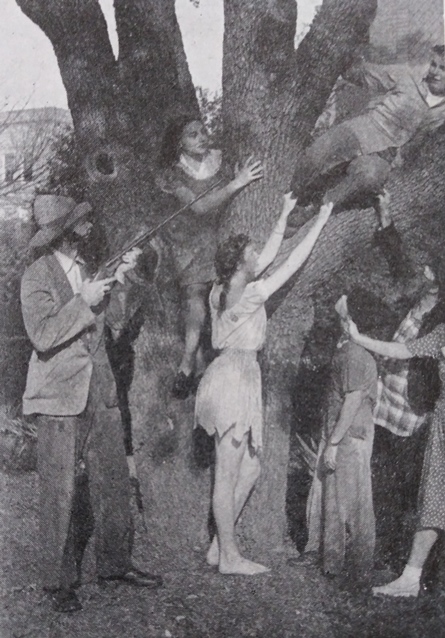
It’s a good time when everyone participates!


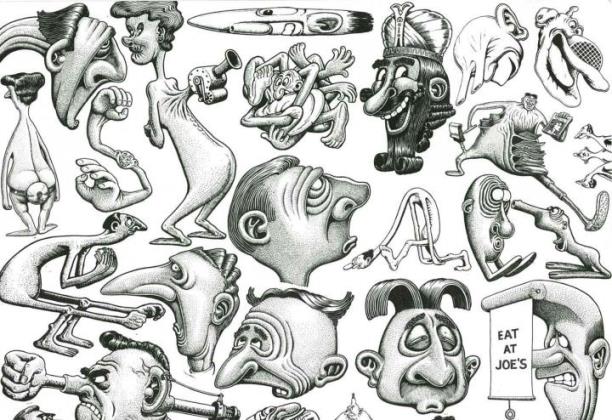
KU Delt pledges dubbed Lena the Hyena as Queen of their Paddle Party in 1946, the same year cartoonist Al Capp Capp introduced Lena as the “ugliest woman in the world.” So hideous that Capp could not bear to render her, he enlisted his readers (in 381 newspapers where his L’il Abner comic strip was seen) to send in their drawing of what they thought Lena looked like. Over 500,000 readers responded. Al Capp persuaded Boris Karloff, Salvador Dali and Frank Sinatra to judge the drawing and the winner was the cartoonist Basil Wolverton. His rendering is what you see above. (https://www.tattooarchive.com)
Personally, I think his grotesque work looks like he was on an endless bad acid trip, but it takes all kinds of artists, and to each his own. Below are tame examples of his other renderings and styles.

As you can see, illustrator Morgan was a master of movement, using his sketches to adeptly convey the energy and complexity of the speakeasy. Also called a blind pig or a blind tiger, a speakeasy was an illicit establishment that sold alcoholic beverages. I was today years old when I learned of the two blind terms. Now it makes sense that I went to a bar called The Blind Tiger in Shreveport 24 years ago, where I met comedian Mario Joyner, who invited my galpal and me to Harrah’s to gamble with him. But that’s another story for another time.
Contrary to the term, it was not a place where it was “easy to speak;” in fact, the opposite was true. It was a place that necessitated one speak easily or softly, as selling and consuming the bootleg booze was illegal. You can see the quiet conversations, imagine the hushed tones, of the clients, keeping it all on the downlow until sufficient intoxication raised their voices. That’s the power of the drink. We’ve all seen a gaggle of middle-aged women drinking margaritas at a Mexican restaurant. Speech is never soft.

From the last sip to a stolen kiss to gossip and entrances, Morgan was able to make the background just as engaging as the foreground.
When the comic was published, the country still had yet three years of Prohibition remaining.
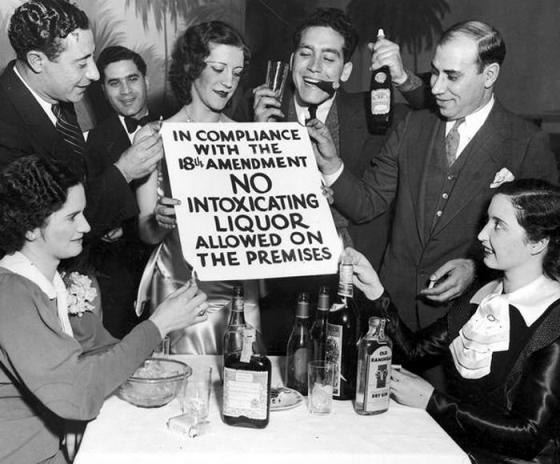
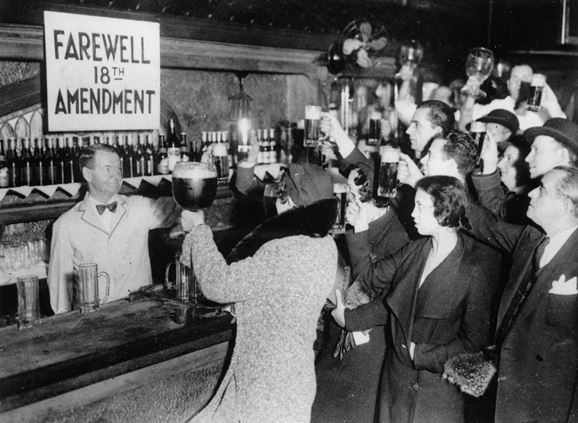
But until then, speakeasies flourished. NYC claimed over 100,000 speakeasies alone. Saloons with player pianos and swinging doors made way for password-protected jazz-playing joints. Instead of aligning with the Prohibition moral compass, American women let loose with drinking, smoking, dancing, bobbing their hair, and donning shortened skirts. Make way the flapper. Gone were basic beer and liquor, as cocktails required mixers to make hootch drinkable. And once folks tasted sugary, fruity drinks, those who had never enjoyed beer and liquor found they enjoyed this new concoction. Organized crime soared. Cops couldn’t keep up with raiding and disposing. It was a losing battle. No wonder FDR repealed the 18th Amendment as soon as he was elected. The woman in the foreground clearly isn’t playing.
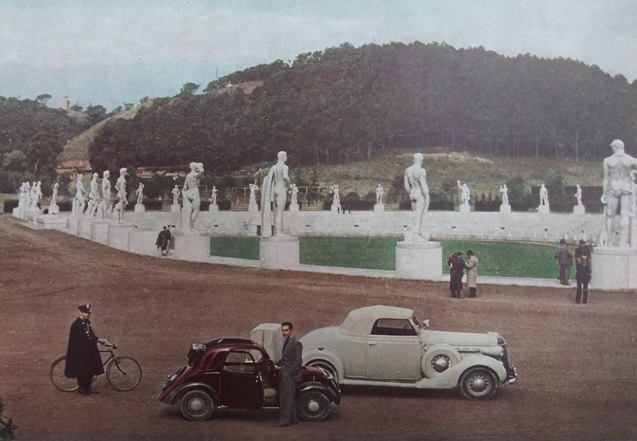
That little red Fiat 500 was a first-year Model A (produced from 1936 to 1948), the smallest car in the world at the time. Italians (like those in this shot in Rome’s Mussolini Stadium) dubbed the midget coupe Topolino (“little mouse” in Italian).
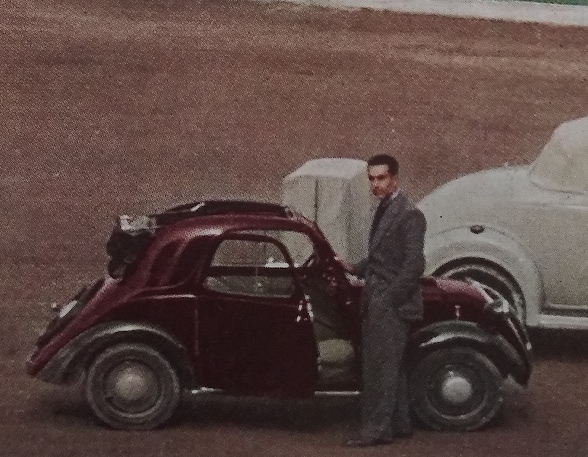
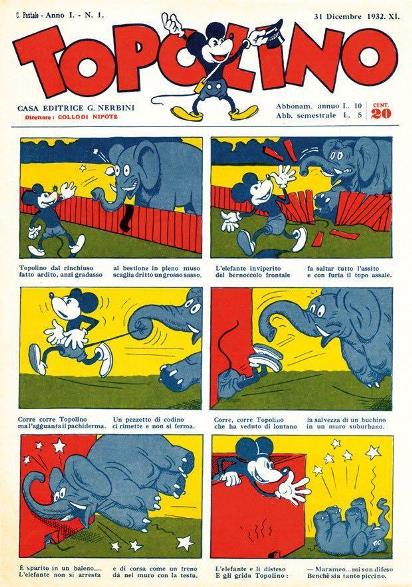
Topolino was also the name of this very famous mouse. Yep, that’s their name for Mickey.
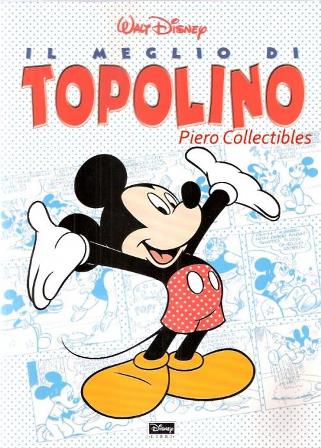
But evidently, cartoons didn’t set well with Fascists back when that photo was taken. Per theguardian.com, “Comics were seen as a vehicle for the values of the Anglo-Saxon democracies … and Mickey Mouse was the last of the American cartoon heroes to be banned because he was a particular favourite with Mussolini’s children; they were among the very few Italians who were able to defy their father with impunity.”
The controlling craziness went so far as to forbid use of “speech balloons” in any comics at all. Who knew the life of a Fascist cartoonist was so hard?
For your further edification, according to hellogiggles.com, Donald Duck goes by “Paolino Paperino” (not pepperoni), Daisy Duck by “Paperina,” and Goofy is “Pippo,” yet for some reason Pluto is still Pluto and Minnie still Minni (close enough).
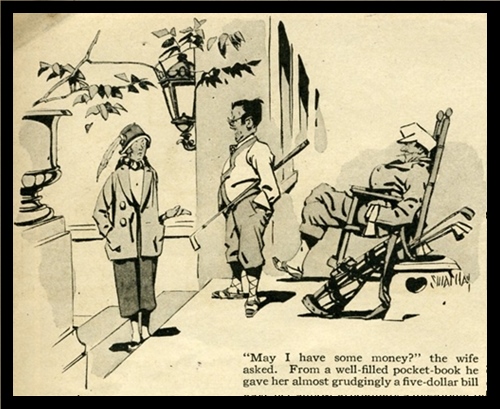
Per www.dollartimes.com, $5.00 in 1925 had the same buying power as $68.36 in 2016.
For more information on Annie Hall fashion, so that this post makes sense to you, visit: www.manrepeller.com.
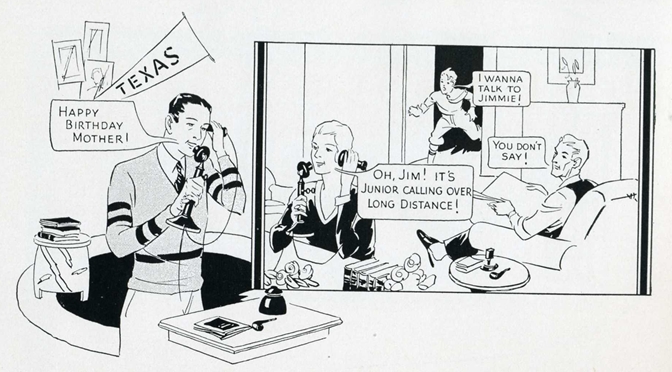
No, this isn’t the Marvelettes, singing that 1962 hit, but I hope it becomes an earworm for you today. 🎶 🎼 🎧 🎤 These images are courtesy of 1930, when talking on the phone required two hands. Multi-tasking be darned!
Do any of you remember the days of five-digit phone numbers (or less), before the seven-digit system?


It’s a pretty common occurrence to find pictures like this of Sadie Hawkins Dances in my 1940s-1950s yearbooks. Tattered clothing, corn cob pipes, and overalls with only one arm on the shoulder were de rigueur. Guests often posed on haystacks such as those above.
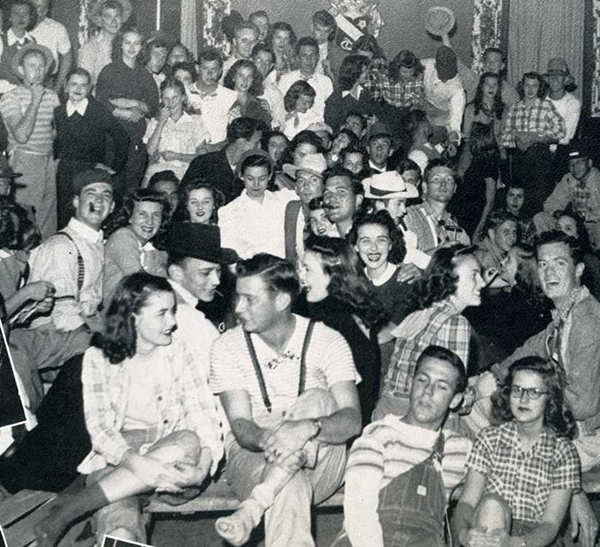
The Sadie Hawkins dance is named after the Li’l Abner homely comic strip character Sadie Hawkins, created by cartoonist Al Capp. In the strip, the unmarried women of Dogpatch, a hillbilly mountain village, got to chase the bachelors and “marry up” with the ones they caught. The event was introduced in the daily strip, which ran on November 15, 1937.
Consequently, Sadie Hawkins dances are traditionally held in November, with the first official one being held on November 9, 1938. Within a year, hundreds of schools followed suit. By 1952, the event was reportedly celebrated at 40,000 known venues. If nothing else, it empowered women to do the asking–and perhaps face rejection.
In the comic, the voluptuous Daisy Mae has the hots for the dense and simple-minded 6’3″ Abner, hardly “l’il” at all.

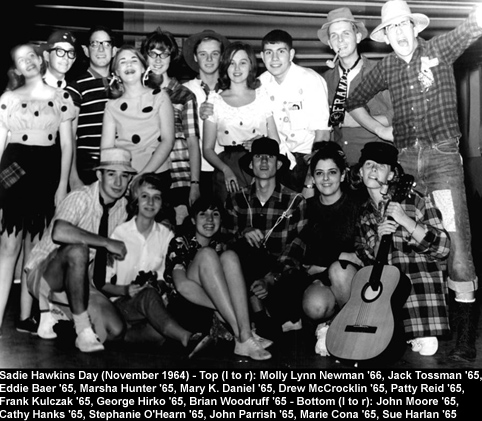
Participants at the dances often wore tattered clothing or plaid shirts.
 In the next photo, you can see that not much had changed as far as attire in the 25 years since its original inception and this 1964 Sadie Hawkins Dance.
What about you? Did you ever attend a Sadie Hawkins Dance? Did people dress up like the L’il Abner characters, or was it purely a girls-ask-boys affair?

 I Don't Get It