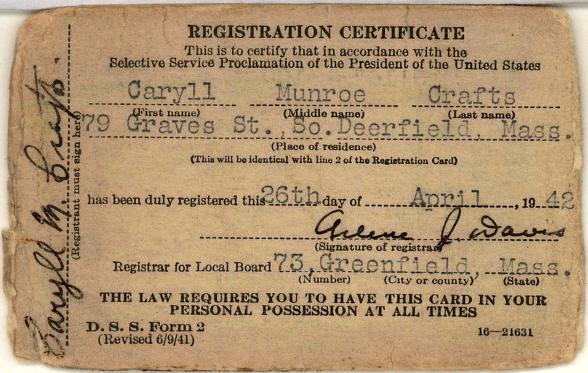
Actually, this woman was a draft service worker during WWII. Men 18-65 and were required to register and keep the card on them at all times. Men age 18-45 were subject to military service. From 1940 until 1947 – when the wartime selective service act expired – over 10,000,000 men were inducted.
(c) Pocumtuck Valley Memorial Association, Deerfield MA.
This cartoon in the Saturday Evening Post depicted a draft board scraping the bottom of the barrel.
During WWII, the not-yet-vanquished German army occupied the north of France, including the port of Cherbourg, which they heavily fortified against seaborne assault. As the only deep water port in the region, it was particularly desirable, so American troops encircled the city in June of 1944 in the Battle of Cherbourg, and handed the Germans their asses five days later, when they surrendered. The fighting left the city in a compromised state. However, in only a month, cargo ships known as Liberty Ships began to arrive, and it became the busiest port in the entire world, with twice the traffic of New York, until the war ended. It has since merged with an adjacent city to become Cherbourg-Octeville.* In this image, we see American soldiers in Cherbourg who appear to have stumbled upon some German wine stores. I’ll drink to that.
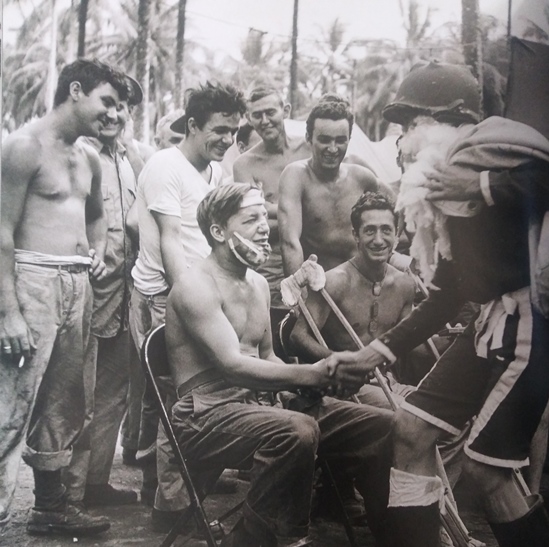
Christmas Day didn’t feel very wintry to these WWII soldiers in the South Pacific. Santa braved the 90 degrees to dispense Red Cross gifts to Army and Marine hospitals and bring some holiday cheer to those missing their families back home.
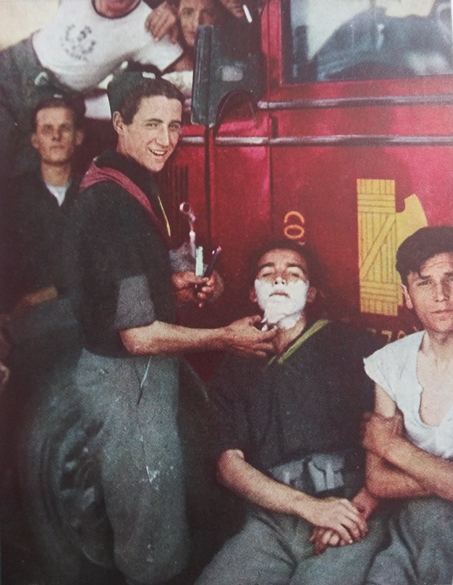
It’s 1936, and these members of the Young Fascists are killing time and facial hair while hanging at comrade camp in Rome. At the time, Mussolini was head of the police state of Italy as its Fascist leader. Fascism is generally a one-party, anti-democratic, often racist dictatorship, so you can imagine the experiences these lads had living under such a regime. Note the painted Fascist badge on the truck above, derived from ancient Rome’s fasces, or symbol of authority, a bundle of rods with a protruding axe blade. Mussolini was evidently the axe.
slideplayer.com
Mussolini made his intentions clear from the start, before he became Il Duce.
When dealing with such a race as Slavic—inferior and barbarian—we must not pursue the carrot, but the stick policy … We should not be afraid of new victims … The Italian border should run across the Brenner Pass, Monte Nevoso and the Dinaric Alps … I would say we can easily sacrifice 500,000 barbaric Slavs for 50,000 Italians …
–Benito Mussolini, speech held in Pula, 20 September 1920
He intended to brainwash the minds of the young men below. Here, they are doing a drill at a camp, to which they came from all over Italy, for a review by Mussolini himself, as part of the organization’s sixth anniversary in October of 1936.
Mussolini equated high birthrates in Africa and Asia as a threat to the “white race,” which led him to ask, “Are the blacks and yellows at the door?” to be followed up with “Yes, they are!”
Below, Romans swarm the Piazza Venezia, so that Premier Mussolini can review the Fascist University Groups, wearing bright neckerchiefs, from his headquarters. The review commemorated the 14th anniversary of the Fascist March on Rome, when Il Duce came to power.
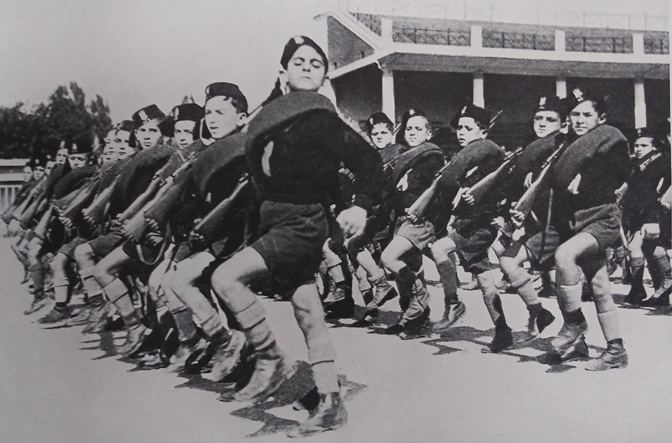
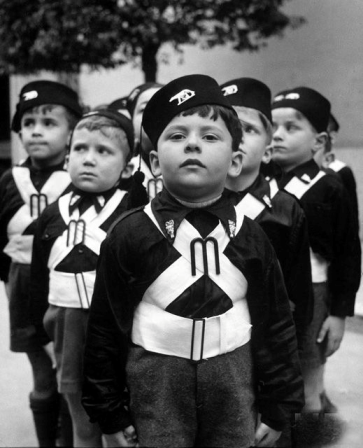
Opera Nazionale Balilla (ONB) was an Italian Fascist youth organization functioning between 1926 and 1937, which took its name from Balilla, the nickname of Giovan Battista Perasso, a Genoese boy who, according to local legend, started the revolt of 1746 against the Habsburg forces that occupied the city in the War of the Austrian Succession by throwing a stone at an Austrian soldier.
These Balillas, aka “boy blackshirts” emulate the posture of Il Duce, with squared shoulders, chins high, quickstepping with toy rifles and blanket rolls during a review.
Acme
Even the very young were indoctrinated.
wikipedia
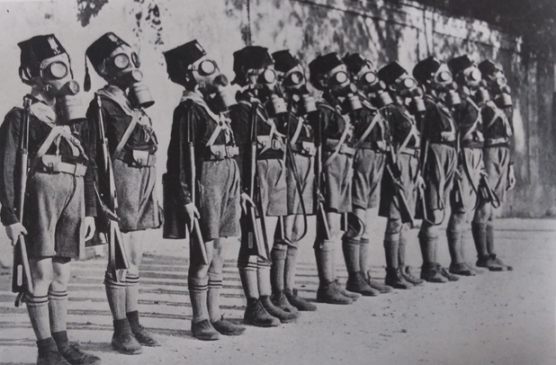
Italian boys donned uniforms at six and received real weapons in their 18th year on the anniversary of Rome’s birth, April 21. These youngsters are doing a drill with gas masks and miniature rifles.
photo by Acme
Fortunately, Italian partisans executed Mussolini two days before Hitler committed suicide, dumped his corpse in the Piazzale Loreto, let folks kick and spit on him, then hung him upside-down from the roof of an Esso gas station. Civilians were then allowed to stone him. Woot.
When we studied WWII in middle school, I remember trying to wrap my head around the murder of six million Jews. It was a number I couldn’t fathom. I currently can’t imagine having a million dollars, and I can’t process that there are over a million people in my hometown now. It’s still too big of a number for me. So when we think about the estimated 26 million Soviet citizens who died during WWII (according to the Washington Post), it’s mindboggling. Can you process that number? There are only 25 million people in all of Australia right now. Less than 26 million in all of North Korea. Can you imagine just annihilating that many folks?
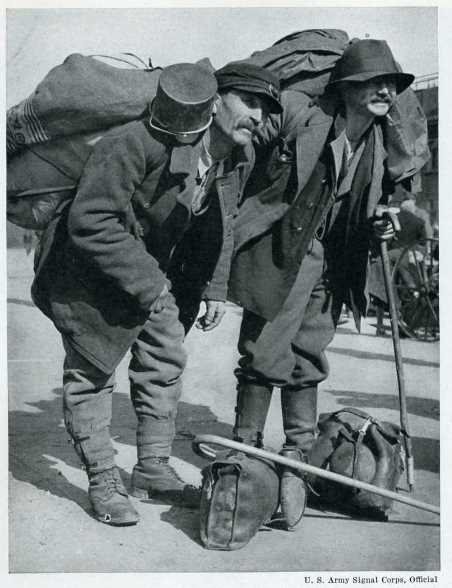
And the men above were spared. Survivors of forced labor camps with nothing to their names. What a hard road that must have been to travel.
Per a January article about Soviet slavery in Russia Beyond:
“They crammed us into wagons, as many as they could, so we couldn’t move our legs,” recalled Antonina Serdyukova, who was captured in Ukraine. “For a month, traveled that way.” Describing her life at a plant near Dresden, she said, “We ate once a day, a bowl of soup, with carrot and swede.”
For the Ostarbeiter (“workers from the east”), forced to live thousands of kilometers from home, fate was like the lottery. Metallurgical plants, mines and farms needed workers, and where they ended up depended on who paid the most.
“When we arrived, there was a transfer point, I would call it a slave market,” said Fedor Panchenko from Ukraine. “In an hour, they sold the whole group of people to different hands.” Among a group of 200 people, Panchenko found himself in a factory, at the ironworks in Silesia (now Poland). For those who came home, life was also hard: German captivity was a stigma. “Fellow citizens despised us,” calmly recalls Panchenko. “I couldn’t apply for a decent job and spent 37 years working at a factory, and if there was any kind of breakage, they would say to me each time: “Oh, no surprise, you worked for Hitler.” Others kept silent about their experience in Germany for decades – they didn’t want the stigma to impact their careers or families.
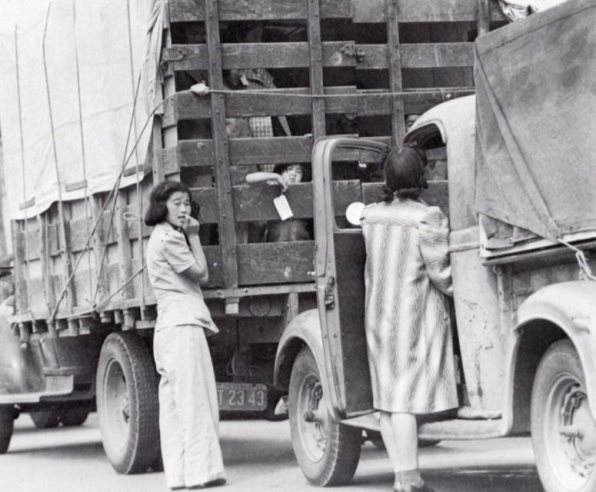
Panic and fear of a Japanese invasion led to the rounding up and internment of Japanese-Americans during WWII per Executive Order 9066. This woman’s body language in Redondo Beach seems to show some panic and fear as well. Both Canada and Mexico followed suit shortly thereafter.
This shot of First Lady Eleanor Roosevelt and Dillon S. Myer, director of the War Relocation Authority, seems to imply no resentment on the part of those who were relocated to Gila River Relocation Center in Rivers, Arizona. Can we leave soon please?
Per http://www.history.com, about 117,000 people were affected by relocation, with a total of 10 housing camps. Two were located on Indian reservations, despite the protests of tribal councils, who were overruled by the Bureau of Indian Affairs. Snap.
Army-directed evacuations began on March 24. People had six days notice to dispose of their belongings other than what they could carry.
Anyone who was at least 1/16th Japanese was evacuated, including 17,000 children under 10, as well as several thousand elderly and handicapped.
These folks are smiling at Santa Anita, but the crowded conditions betray them. Although they were not met with the horror and atrocity of concentration camps, a cage is still a cage is still a cage, especially since most of the people were American citizens.
Getty Images
The last Japanese internment camp closed in March 1946.
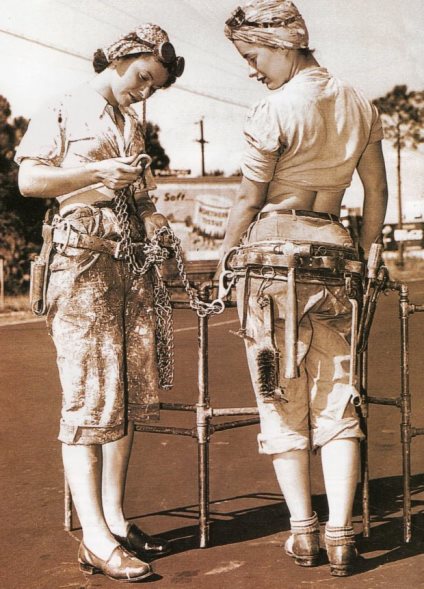
With so many men overseas during WWII, women filled the vacancies in a number of jobs, including painting power poles for Florida Power and Light. In Reminisce: Pictures from the Past, the husband of Virginia Kompe (right) explains how Virginia and her sister, Shirley, spent the winter of late ’44 into early ’45 “raising ladders and hoisting the housings for the bases of the poles. They also served as grunts for the linemen.”
One notices in 1940s hairstyles that the hair just beyond the temples was often smooth or pinned back, making the voluminous curled areas appear ever poofier in contrast. Ever wonder why you don’t see pics of these women with long bangs in their faces (like the umpteen actresses on talk shows who constantly wipe their hair to the side)? There’s no Crystal Gayle or Kim K. hair here. And it wasn’t just fashion.
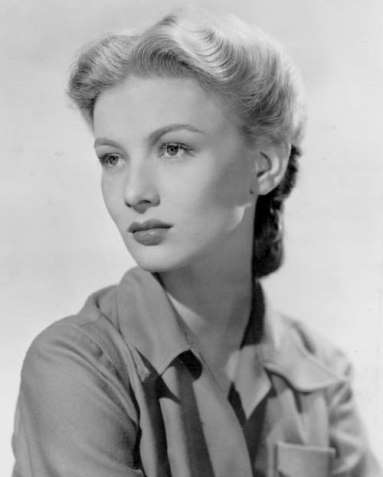
Able-bodied men were overseas, and women were manning the production lines. Long hair (or even one stray lock) could get caught in machines and not only injure the workers, but put production on hold until she was freed. Even Veronica Lake (of the oft-imitated peekaboo hairstyle) changed her style during the war effort, showing the dangers of untamed, unpinned hair.
flashbak.com
This youtube video explains why safety is of the utmost importance during factory work.
The end result is a new and improved, less seductive 4’11” Veronica, donning the updo called the “Victory Roll.” Sleek = Safe. And as you can see in the video, from behind, her hair makes a dazzling V for victory.
Many stars wore them, including Rita Hayworth.
(Photo by Pictorial Parade/Moviepix/Getty Images)
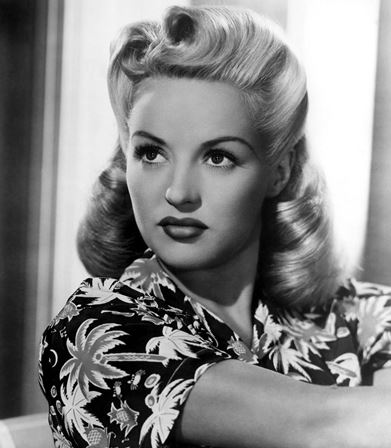
And Betty Grable.
Pinterest
Now you know why your vintage pin-ups often wear their hair in an updo, and why the Allies won the war.
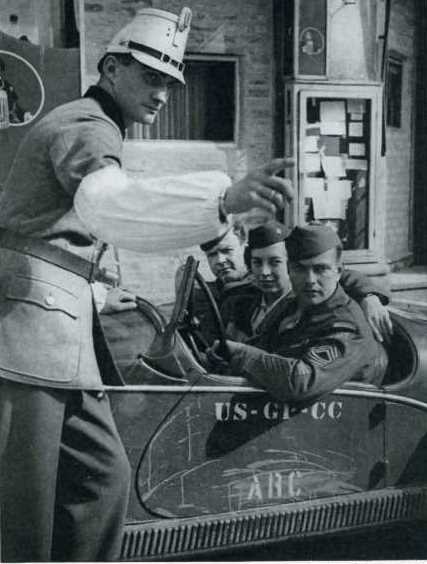
An American Red Cross worker is snugly sandwiched between two soldiers in a requisitioned vehicle, as a Berlin traffic policeman directs them during a sightseeing tour.
photo by Acme
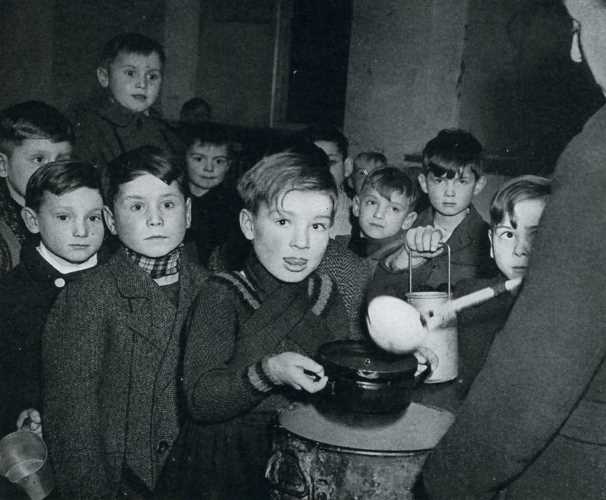
These hungry little tots are lined up for hot soup at one of the many Berlin soup kitchens. The feeding program began in November 1945, just months after WWII ended, seeking to aid the diet deficiencies incurred by the kids.
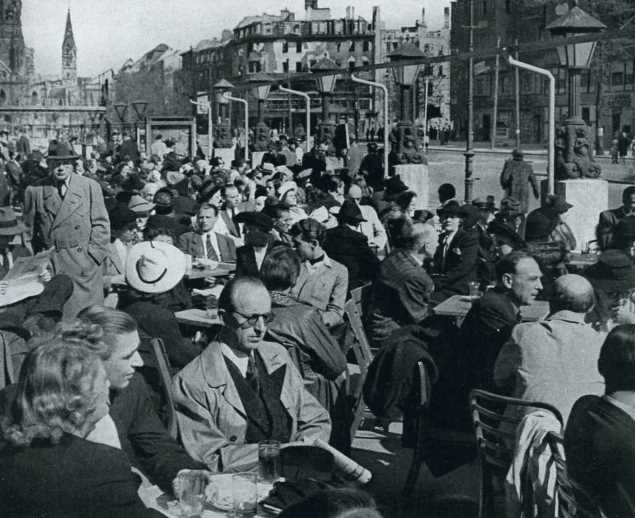
The caption on this next National Geographic image read Berlin Still Has Sidewalk Cafes, But Little Gayety. The glum faces in this British occupation zone belie the fact that it was, in fact, Easter. This wide strip of the Kurfürstendamm, the famous avenue in Berlin, was once well-known for shops, cabarets, cafes, and dance halls. Here, patrons drink imitation fruit juices and “ersatz” coffee, as there was no access to fine wines and liqueurs of yore.
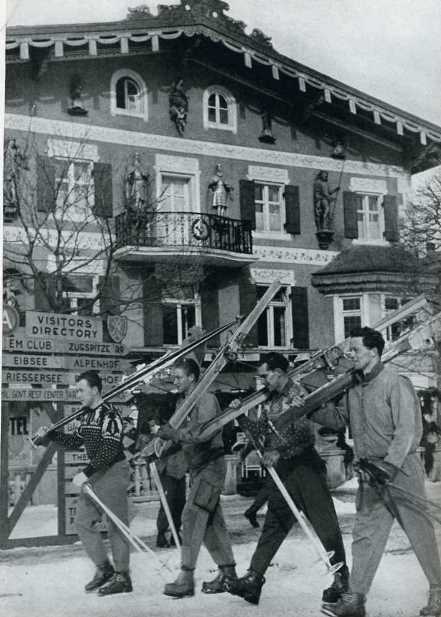
For a larger dose of fun and frolic, Allied-victorious American soldiers made the six hour trek south of Berlin to Garmisch-Partenkirchen, where they spent hours on the slopes.
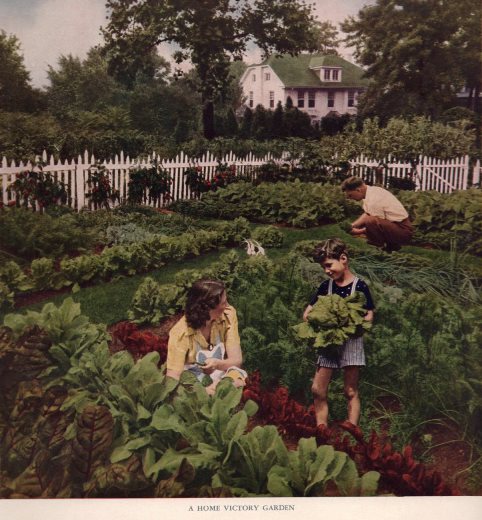
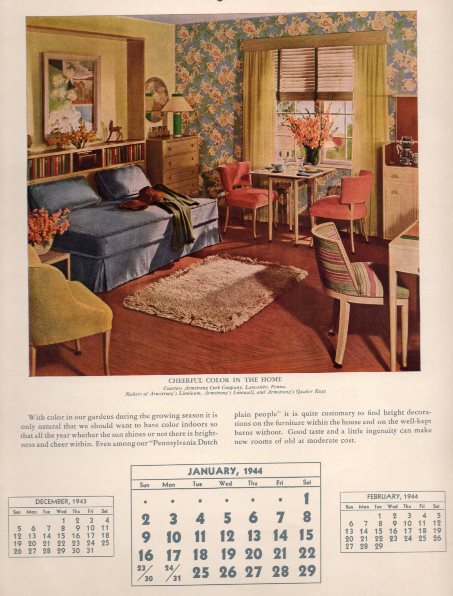
This 1943-1944 calendar from the McFarland Company is full of lovely images, including this victory garden, popular during WWII. The floral side of gardening is covered in the month of July.
Bright colors fill the room for January.
And who wouldn’t want their yard filled with wisteria?
















 I Don't Get It