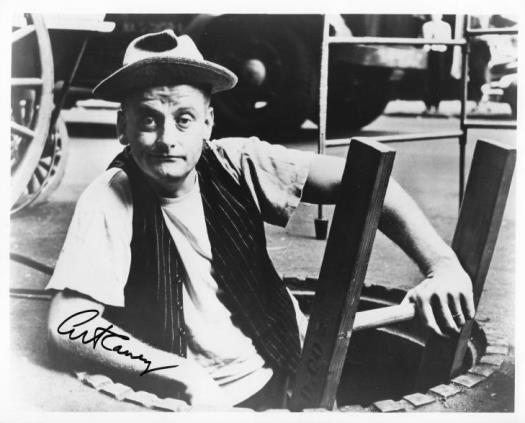
The coalminers above are relaxing with pints in a colliery club in Yorkshire, England. Colliery is a word I’ve never used, so I had to pull out my big, red Webster’s dictionary (no offense to Merriam) and look it up. A colliery is a coal mine and all the buildings and equipment which are connected with it. This building in particular served ale. And I couldn’t help but find the resemblance of this man (and his collapsed smirk) to a certain mid-century actor.
Enjoy this peek inside the post-war colliery and think about these men, how exhausted they must have been, lungs full of coal dust, and how they gathered to blow off steam.
Back in 1987, Cindy Crawford may have been bronzed (and possibly narcoleptic), but she lacked the use her right eye.
Once her tan had faded, only her left eye was functional, and seems to have contracted a nasty case of pink eye, to boot.
Linda was the next victim of vision impairment, which may explain her shoddy yellow eye shadow application.
Christie’s left eye is hidden beneath this fetching safety pin hat. It might prove helpful if she needs emergency hemming.
Iman was only partially impaired by her curly strands. However, her poor lobes were taxed with cutlery. Nothing like the feel of prongs scraping against your collarbone to remind you that forks are the enemy of supermodels.
Nowadays, it’s important to have both eyes free of impediments so that you can properly text while driving. Eyes work better in tandem. Just ask this guy!
National Geographic Society, Finlay Photography by Bernard F. Rogers, Jr.
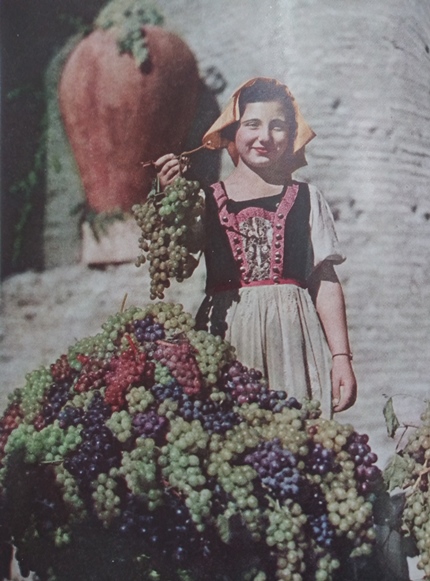
While this pretty maiden humbly offers two bunches of grapes on sticks during a Roman Grape Festival, her old-fashioned costume betrays her. She is no country bumpkin. As the article states, her wristwatch shows that she is a modern woman, and chances were high that she was actually an extra from a nearby movie studio.
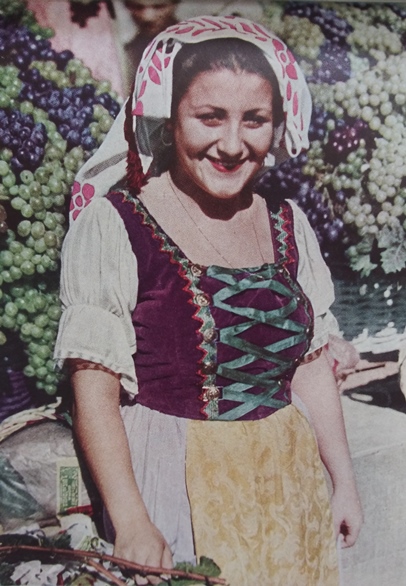
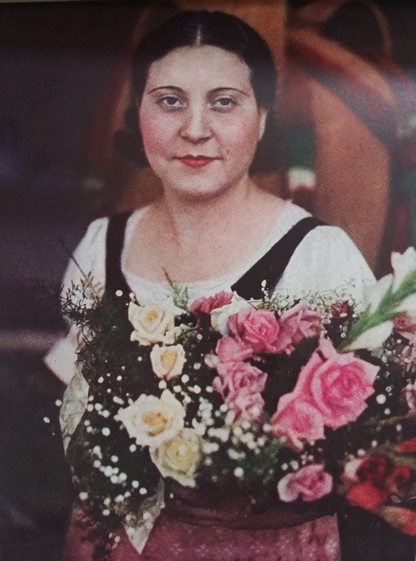
This grape girl wrapped her finest grapes in paper packages, while the salesgirl below sold roses in assorted colors.
If a flower girl could not carry her burden, she used a beast.
Bernard F. Rogers, Jr.
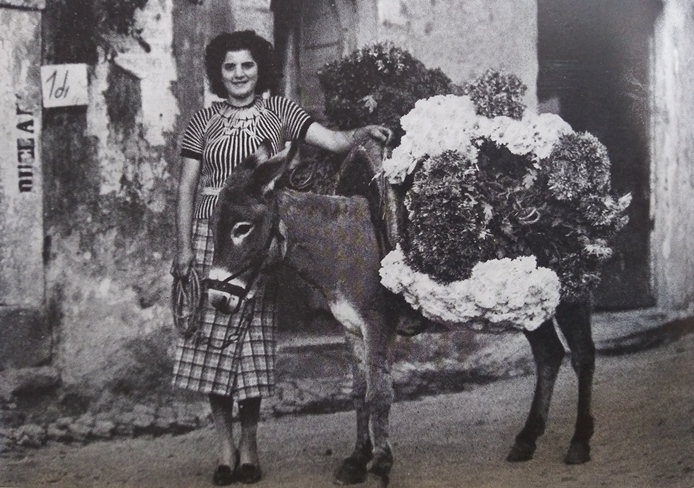
This donkey was piled high with daisies, violets, and chrysanthemums, brought in from the fields to Nemi, near Rome. With such plentiful bounty, vendors often gave faded flowers to children to beat on the pavement and watch the petals fly.
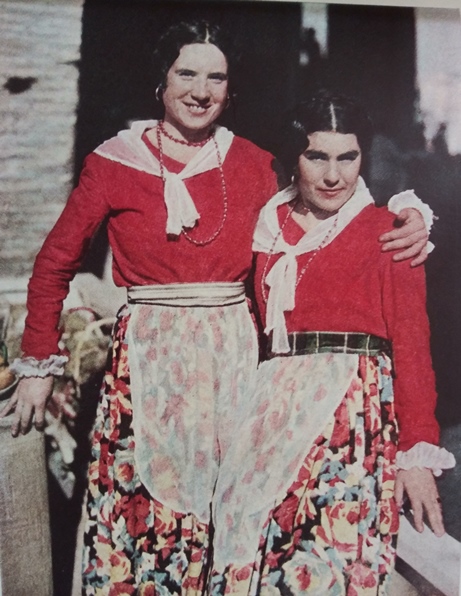
Those who weren’t selling got into the spirit by wearing provincial costumes to celebrate products from the many district vineyards, displayed in the Basilica of Constantine. That’s a serious middle hair part.
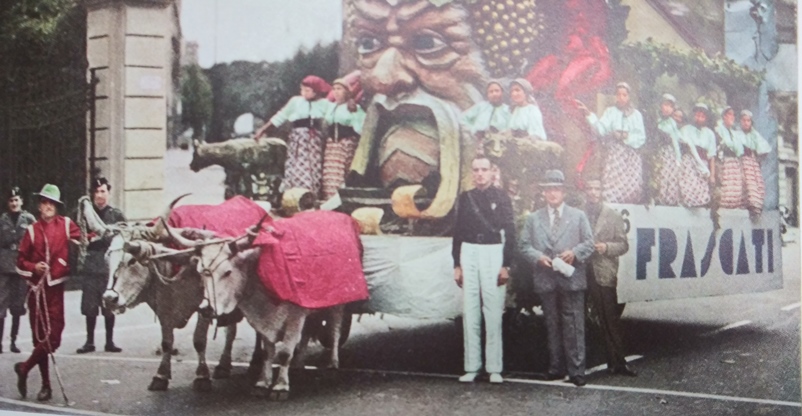
Once the Grape Festival got underway, 25 floats made their way down the streets. This one depicts Bacchus (Dionysus), the ancient Roman and Greek wine god. As the oxen moved, the tongue revolved as if lapping wine. Ew.
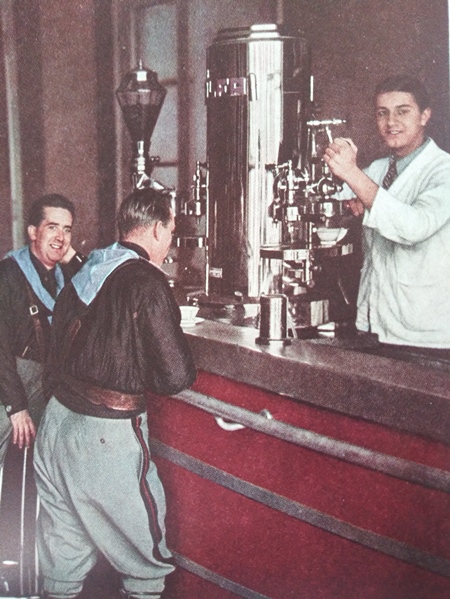
Granted, the fellow on the left looks 57, but apparently, he and his buddy were both Roman university students, sipping caffe espressos made from Brazilian beans between classes way back in 1937. Each student’s neckerchief bears colors denoting his course. Would you get a new neckerchief each time you changed majors?
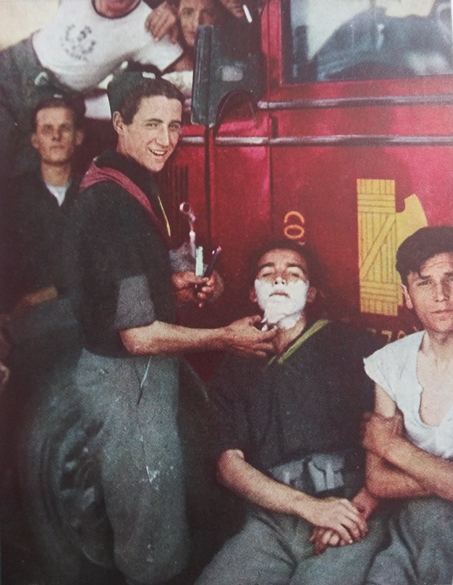
It’s 1936, and these members of the Young Fascists are killing time and facial hair while hanging at comrade camp in Rome. At the time, Mussolini was head of the police state of Italy as its Fascist leader. Fascism is generally a one-party, anti-democratic, often racist dictatorship, so you can imagine the experiences these lads had living under such a regime. Note the painted Fascist badge on the truck above, derived from ancient Rome’s fasces, or symbol of authority, a bundle of rods with a protruding axe blade. Mussolini was evidently the axe.
slideplayer.com
Mussolini made his intentions clear from the start, before he became Il Duce.
When dealing with such a race as Slavic—inferior and barbarian—we must not pursue the carrot, but the stick policy … We should not be afraid of new victims … The Italian border should run across the Brenner Pass, Monte Nevoso and the Dinaric Alps … I would say we can easily sacrifice 500,000 barbaric Slavs for 50,000 Italians …
–Benito Mussolini, speech held in Pula, 20 September 1920
He intended to brainwash the minds of the young men below. Here, they are doing a drill at a camp, to which they came from all over Italy, for a review by Mussolini himself, as part of the organization’s sixth anniversary in October of 1936.
Mussolini equated high birthrates in Africa and Asia as a threat to the “white race,” which led him to ask, “Are the blacks and yellows at the door?” to be followed up with “Yes, they are!”
Below, Romans swarm the Piazza Venezia, so that Premier Mussolini can review the Fascist University Groups, wearing bright neckerchiefs, from his headquarters. The review commemorated the 14th anniversary of the Fascist March on Rome, when Il Duce came to power.
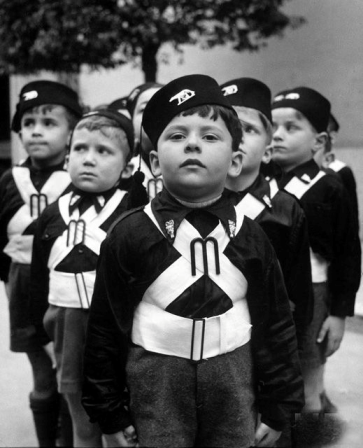
Opera Nazionale Balilla (ONB) was an Italian Fascist youth organization functioning between 1926 and 1937, which took its name from Balilla, the nickname of Giovan Battista Perasso, a Genoese boy who, according to local legend, started the revolt of 1746 against the Habsburg forces that occupied the city in the War of the Austrian Succession by throwing a stone at an Austrian soldier.
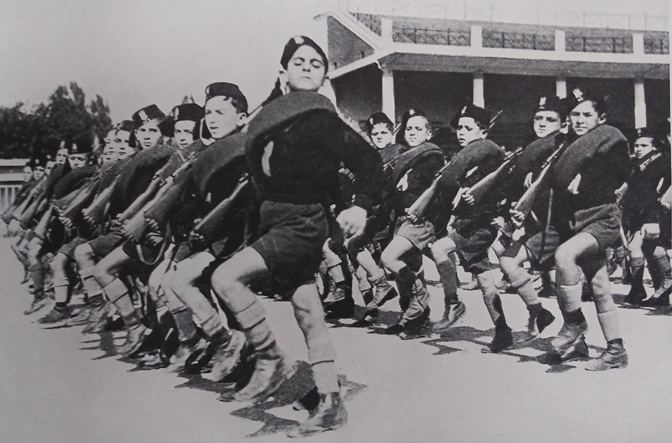
These Balillas, aka “boy blackshirts” emulate the posture of Il Duce, with squared shoulders, chins high, quickstepping with toy rifles and blanket rolls during a review.
Acme
Even the very young were indoctrinated.
wikipedia
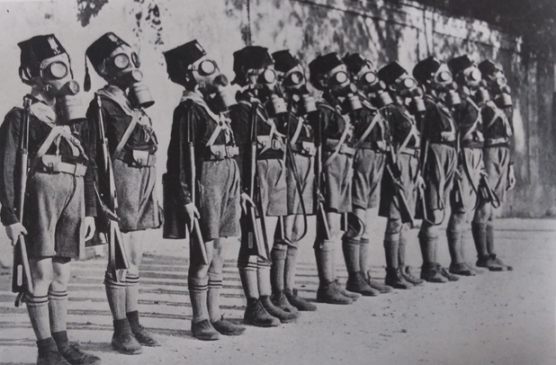
Italian boys donned uniforms at six and received real weapons in their 18th year on the anniversary of Rome’s birth, April 21. These youngsters are doing a drill with gas masks and miniature rifles.
photo by Acme
Fortunately, Italian partisans executed Mussolini two days before Hitler committed suicide, dumped his corpse in the Piazzale Loreto, let folks kick and spit on him, then hung him upside-down from the roof of an Esso gas station. Civilians were then allowed to stone him. Woot.
I love how early ads doled out the facts. The US has 13 phones for every 100 people, and Europe has less than three. You better recognize that Bell Telephone worked its hiney off to get that done.You’re welcome, America.
While Italian innovator Antonio Meucci is credited with inventing the first basic phone in 1849, and Frenchman Charles Bourseul devised a phone in 1854, Alexander Graham Bell won the first U.S. patent for the device in 1876.
And while this Bell ad states there were 34 million phones in the world in the summer of 1936, today there are 2.71 billion smartphones in use. Per http://www.bankmycell.com, 35% of the world has a smartphone. And most of us are addicted. Perhaps you are even reading this on your phone now, although I wouldn’t recommend it. You need a big monitor to enjoy these pics. 😉
Last night, my husband and I discussed the large long distance phone bills we used to accrue in the 90s, how I would call my mom collect at Christmas once I arrived at my grandparent’s house, finding a pay phone in the mall to call home, or a phone booth outside, complete with yellow pages (which some folks ripped out). All things our son will never understand. And while we still have a landline, we don’t have a rotary, so he won’t experience that either. And frankly, most of his communication is texting, so rare is the time he even speaks on a phone at all. Remember when we looked forward to hearing each other’s voices?
I got on my hands on a tall stack of vintage Nat Geos this weekend, all from the 20s and 30s. And yes, even in 1928, they had colorful pictures of bare-breasted tribal women. Odd.
In this particular article about Michigan, “Mistress of the Lakes,” they declare Detroit a “City Without Slums.” Now that’s quite the declaration. Clearly things were going well in 1928. One of the manufacturing jobs listed, in addition to cars and gold pens, was the lumber industry. And let me remind you, if you’ve never read a National Geographic article, they are loooong. There was no TV yet, not everyone had radio. So this article on Michigan alone goes from page 269 to 325. Crazy, right? I won’t read it all. But I’ll share these picshas.
The curiously-coiffed gal above is the assistant cook at the lumberyard, who retires to the rear of the cook shack at noon each day to sound the call for “dinner,” which is what we call lunch.
Into the room, the men would file for nourishment. A unique feature of the lumber camps was absolute silence during eating. They maintained that it prevented arguments, which could lead to “brawls, broken dishes, and broken heads,” none of which that cook up top would want to fix. For those with misophonia, who lose their minds when forced to listen to others eating, this would have proven a challenge. But mental conditions were not coddled in their day, so group masticating it was.
The author of the article asserts that strong and faithful horses were better able to do certain lumber camp work better than “any motors,” but I imagine that didn’t last long.
While it was not uncommon to see huge rafts of pulpwood float downstream for consumption of paper mills, much wood was loaded onto ships and processed throughout Michigan.
This particular vessel below has just discharged a cargo of one million board feet of rough lumber from a Canadian port, which Saginaw’s mill will finish for ready-cut houses. Per michiganhistory.leadr.msu.edu, Saginaw hit its peak in the Lumber Era during 1882, with 1,001,274,905 board feet of timber cut in mills along the Saginaw River.