Dust In The Wind, Part 3

Time to get the H out of Dodge.
The Dust Bowl by Duncan & Burns
all images from “The Dust Bowl” by Duncan & Burns

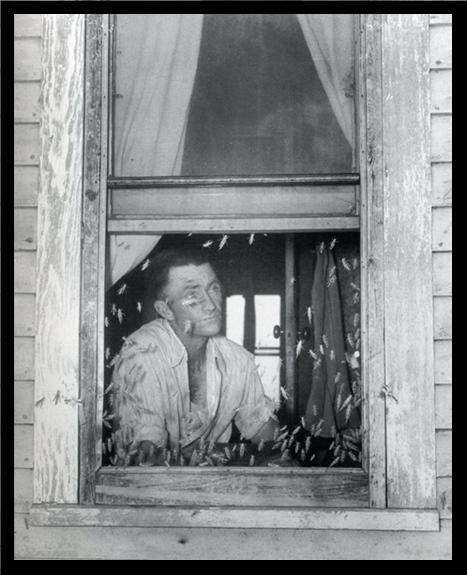
A New Mexico man sits in a stupor, as some of the millions of grasshoppers that invaded the land swarm his window.

Said Sam Arguello of Union County, New Mexico in 1938:

You’d pull on the reins and the horse would slide on the grasshoppers. And that’s a fact. That’s not make-believe. I went through it. I know it.

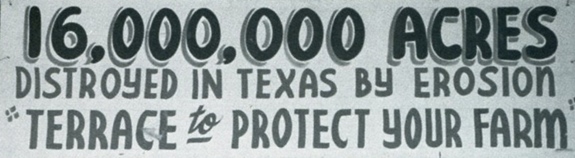
If it wasn’t grasshoppers, it was erosion. thedustbowl-014
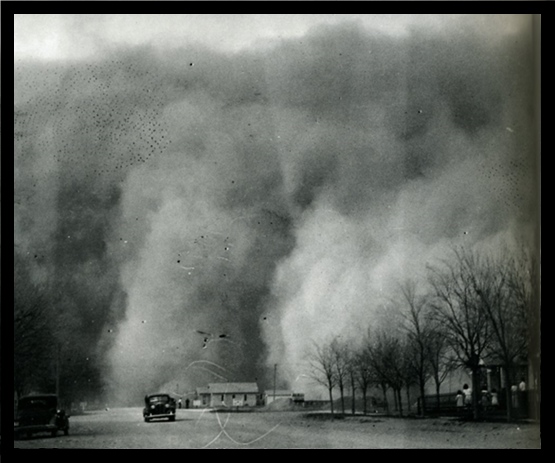
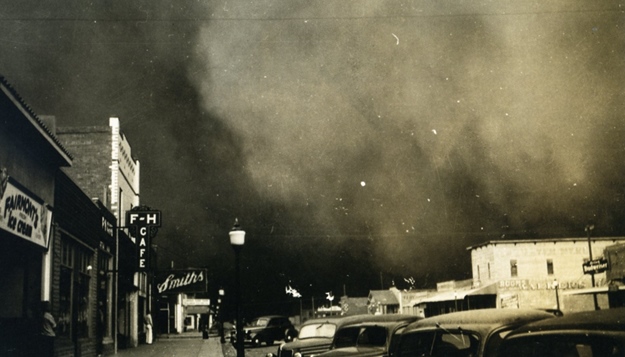
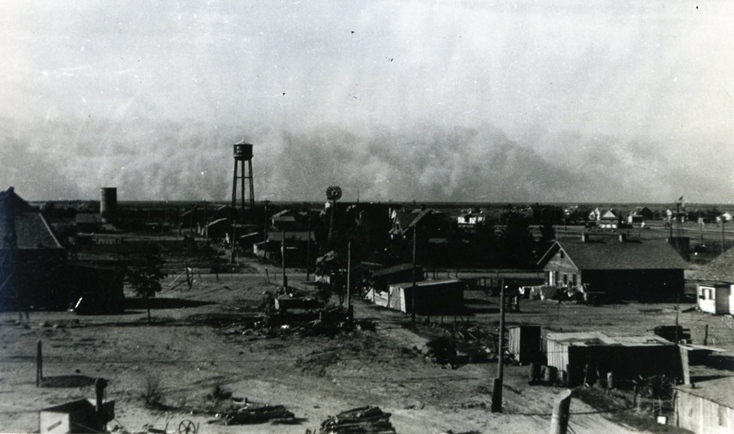
And with erosion, came the dust. Below a black blizzard hits Elkhart, Kansas on May 21, 1937.
thedustbowl-015

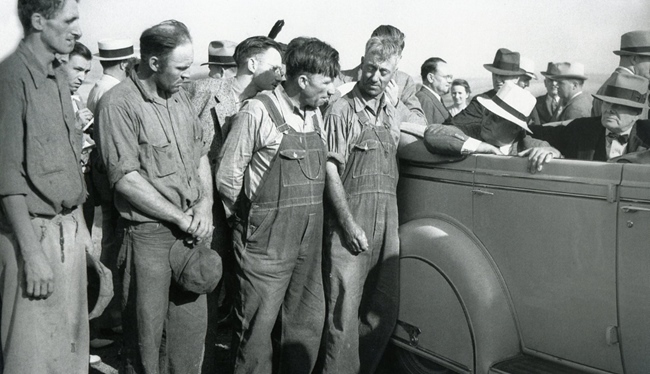
FDR encouraged these Boise City farmers to stay put, offering the promise of help and hope. Said Timothy Egan, “Here’s a land that God Himself seems to have given up on, getting the backhand of nature.”
thedustbowl-016

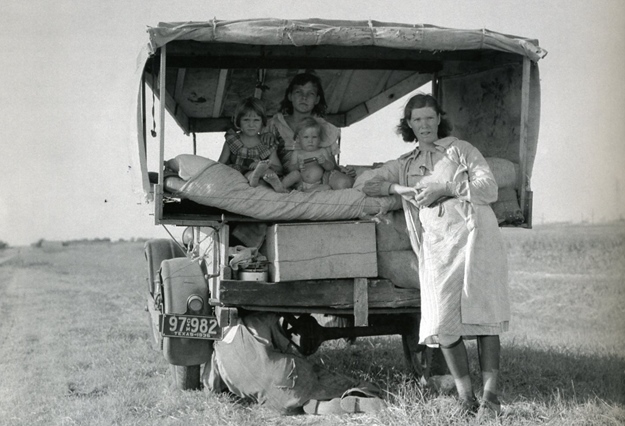
But many could not heed his words. The Dust Bowl exodus was the largest migration in American history. According to www.pbs.org, by 1940, 2.5 million people had moved out of the Plains states; of those, 200,000 moved to California.

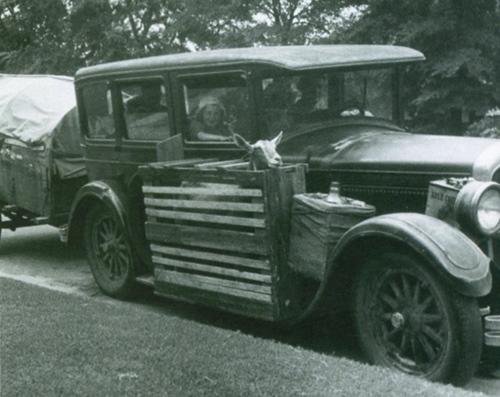
This Texas family loaded up their goat and hit the road, Jack.
thedustbowl-012

Complications would arise, but this Texan father was able to repair the back axle while his family waited in the shade of a tarp.
thedustbowl-013

Eventually, the drought let up, and precipitation returned. By the end of 1939, the Dust Bowl had shrunk to 1/5 its previous size. By 1940, the drought was officially over, and many farmers harvested their first profitable crop since 1930.

According to Lorene Delay White in The Dust Bowl: An Illustrated History:

Now one will ever know what it meant to us to have it rain. That’s what we prayed for, what we yearned for, was the rain that came that would soak in to the ground and let us raise a crop and eventually stop the dust.
Dust In The Wind, Part 2

The Dust Bowl by Duncan & Burns
Black blizzard approaching Springfield, Colorado: The Dust Bowl by Duncan & Burns

thedustbowl-007

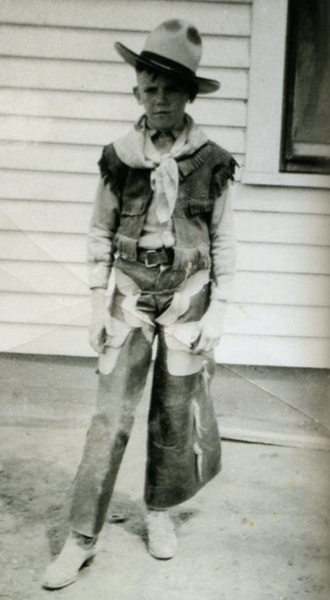
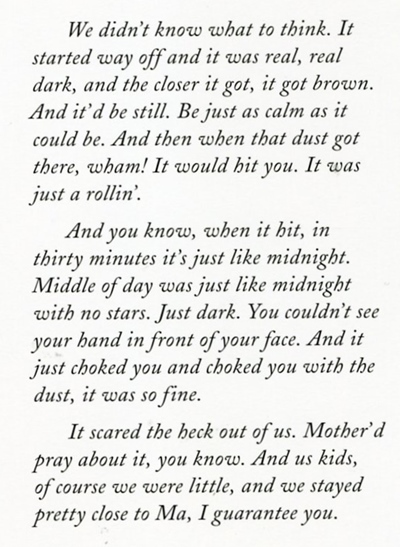
These were the words of young Robert “Boots” McCoy from an area near Boise City, Oklahoma in January 1932, as he huddled with his older sister Ruby Pauline and pregnant mother.

Boots McCoy
Boots McCoy

Dust In The Wind, Part 1

thedustbowl-001

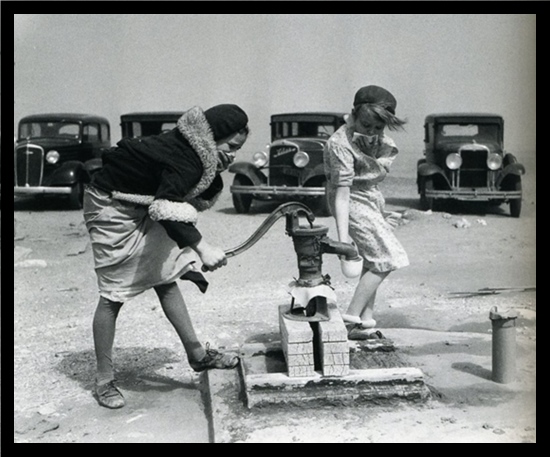
Two Baca County, Colorado girls cover their mouths while pumping water into a cup in March 1935.

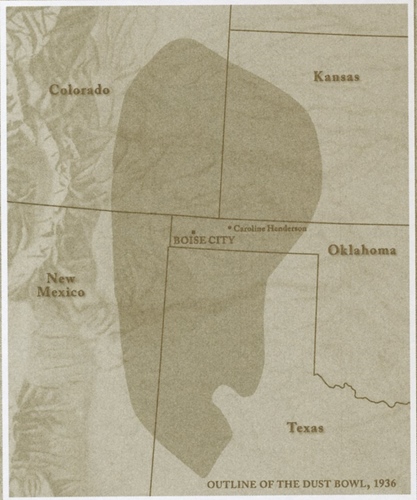
The Dust Bowl by Duncan & Burns showcases images and stories from the five states affected by the “worst man-made ecological disaster in American history.” Below is what is considered the Dust Bowl during the 1930s.

thedustbowl-004

Wind, drought, and poor farming practices combined to create a perfect storm of “black blizzards” across millions of acres, lasting nearly a decade.

thedustbowl-003

Imagine 14 million grasshoppers per square mile descending upon parched fields, while millions of tons of topsoil blew away each year, seeping into every crevice imaginable.

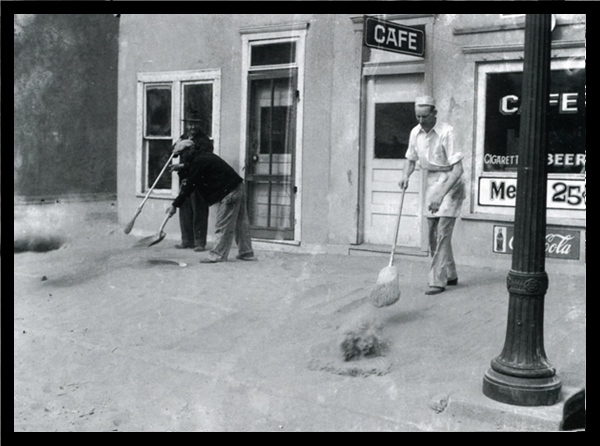
Syracuse, Kansas shopkeepers kept their arms strong by continually sweeping the dust from their sidewalks. thedustbowl-002

This paperboy in Ness City, KS donned a dust mask and goggles in order to complete his job. One imagines the headlines maintained Living in the Dust Bowl Stinks.

thedustbowl-005

All I’m Saying, Myrtle, Is I Wouldn’t Go Out In My 4 Million Dollar Ring After Posting It On Instagram

Family of Man by Edward Steichen

Never Mess With A Hoopa Woman

Women of the West by Luchetti & Olwell

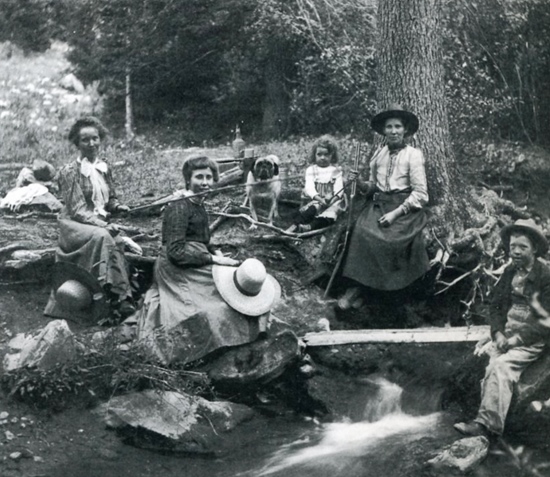
Happy new mama and gruff bodyguard at the Hoopa Indian Reservation in 1896.

For more information on Hoopa peeps, visit https://www.hoopa-nsn.gov/, whose site states: “Serving the people since time immemorial.” That’s a long time.

War Is Over–Now What?

goodolddays003
Time Life: The Good Old Days 40s-50s

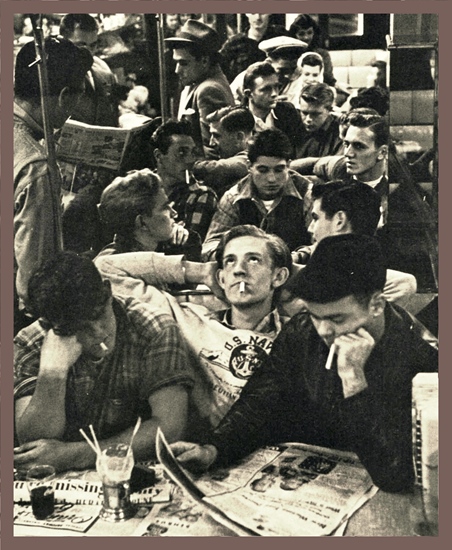
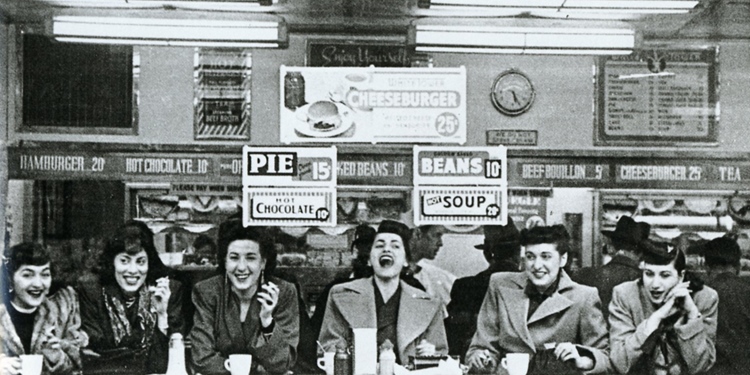
The lucky servicemen who returned home from WWII not in a box often brought home nicotine addictions, PTSD, and not a clue as to where to go from here. Within a year of the end of WWII, six million GIs had drawn an average of two months’ unemployment benefits, calling themselves members of the 52-20 Club, so named for the unemployment pay of $20 for 52 weeks granted discharged servicemen. Rather than quickly return to work, some men (like those in this Long Island soda shop) spent some downtime reading the paper, sipping malts, taking a drag, and sometimes–reassessing.

Talking Shop On Rug Beatin’ Day

Russell Lee, Bureau of Mines

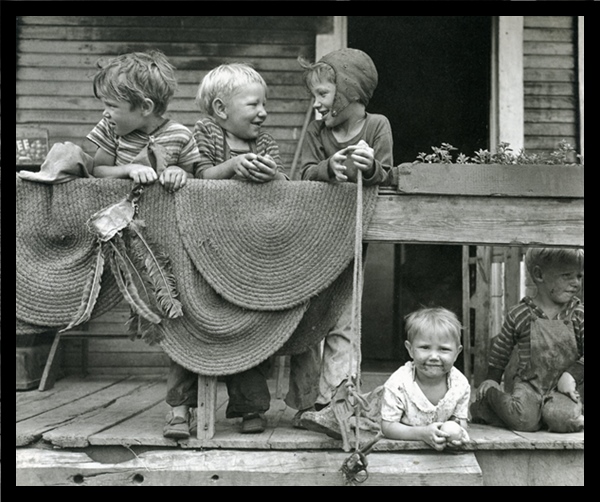
You may have seen some of Russell Lee‘s fantastic images before. This is one of my favorites. Lee passed away in 1986 here in Austin, Texas, and this year, the former Lee Elementary was renamed Russell Lee Elementary in honor of the photographer, replacing the original namesake, Robert E Lee. I don’t have to ask why they are phasing out anything named in honor of Confederate generals; I imagine it is all part of the collective disappearance of anything related to the politically-incorrect South. I understand that folks don’t like what the Confederacy stood for (including the flag); but that doesn’t mean all of its soldiers should be erased from history. I guess the offensive ideology of The Antebellum South (which can’t be boiled down to just one issue) trumps honoring any of their leaders’ military strengths. In any event, I’m not in charge, and Texas isn’t even part of The South. I got no dog in this hunt; I just love chunky-faced kiddos, and the mutual expression those two boys are sharing.

Civil War Bridge On The Pamunkey

US Signal Corps Photo (Brady Collection) in National Archives

In The American Heritage History of American Railroads by Jensen, this 1862 image shows a bridge under construction. Major General George McClellan of the Union Army brought locomotives and cars by ship from Baltimore and ran trains as close to four miles to the Confederate capital. The workmen are seated, and to the left is a photographer’s field darkroom. At that time, photographs had to be developed immediately and while wet.

To their left , a locomotive was arriving on a ship in White House Landing on the Pamunkey River.

railroadsinamerica016

Here is another image of the field darkroom, invented by Matthew Brady.

http://www.sonofthesouth.net/

The wagon would carry the chemicals, glass plates, and finished negatives. Can you imagine what would have happened if the horses got startled or took off at a gallop?