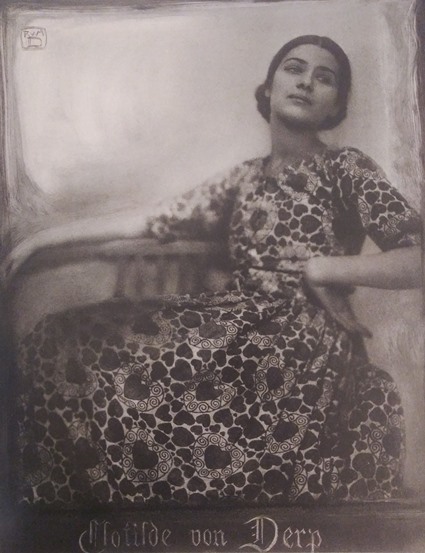
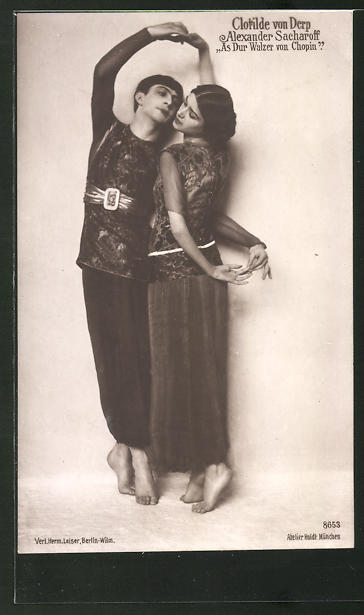
Okay, y’all, there’s a lot to deal with here. First off, it says Motilde to me. That’s what my eyes see. But her name was Clotilde von Derp, an expressionist dancer who married another dancer but refused to take his name of Sakharoff. I would have taken that over Derp any day, but this was before derp was a thing.
If you ask anyone under 40 what a derp is, they’ll most likely think of this, which is a word for foolishness or stupidity.
But von Derp it was. And really, that’s just her pretend stage name. Her legit name was Clotilde Margarete Anna Edle von der Planitz. That’s a lot to embroider. Photographer Rudolph Duhrkoop took the pic in 1913.
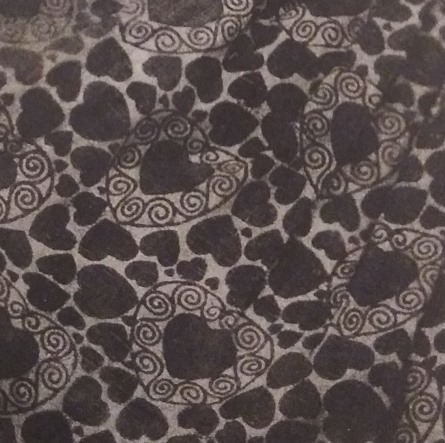
Couldn’t you just fall into the heart patterns of her dress?
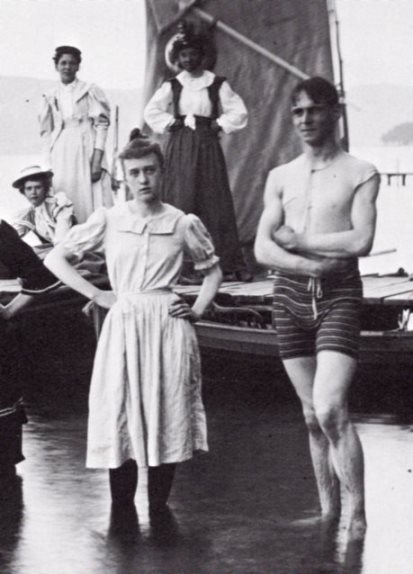
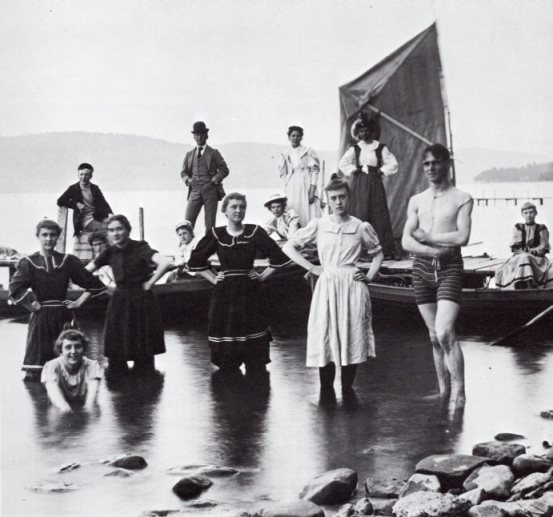
Is anything more refreshing than a lakeside dip in seven pounds of swimsuit? It looks like a good way to get pulled under by a current. And who’s got time for a watery grave these days? Hard pass.
NY State Historical Association, Hometown USA
At the turn of the century before the turn of this last century, folks was modest. Bared female knees were considered skanktastic, although this man’s naked knees are evidently enjoying 1900, where the living is easy. He does seem a bit cold, though. Perhaps he also should have worn a button down dress.
Photographer Telfer snapped this pic in Cooperstown, NY, at the waters of Otsego Lake. Americanheritage.com says, “Most people know Coooperstown as the home of novelist James Fenimore Cooper, a beautiful resort, and as the place where baseball was supposedly invented by Abner Doubleday.” But I’ve never heard any of those things until about three minutes ago, so there you are.
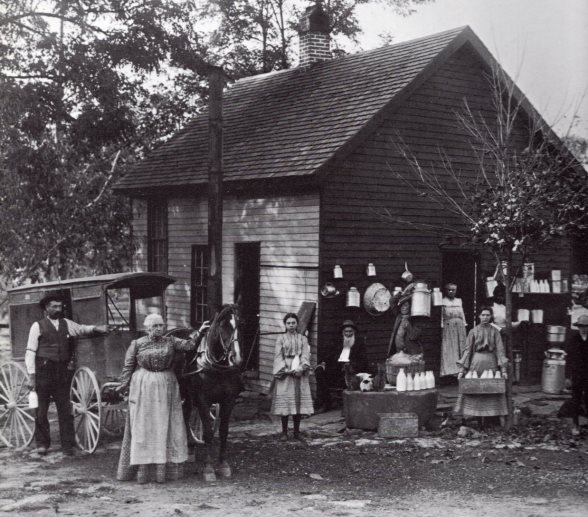
The milk isn’t sour, but the looks on these lasses sure are. The middle makes the picture. A bearded geezer and a man hoofing a canister. Love it! AJ Earp took this pic in 1905 at the Cliff Owen dairy farm in Winchester, Kentucky. The milk was probably raw and definitely whole. I don’t trust folks who drink skim.
Every year in the United States, over 300,000 people with appendicitis have their appendix surgically removed. While over 11 million cases are reported annually, deaths lie somewhere around 50,000. Still seems like a huge number and a bad way to go, right? The percentage of deaths was much higher before this fabulously-stached bald man in the middle, Charles McBurney, came up with what is called “McBurney’s Incision.” Rather than cutting through the abdominal walls, he made a diagonal incision that split the appendix to expose it.
In this 1900 pic, the surgeon is assisted by both staff and students. No surgical or scrub caps here. But at least most of them are wearing gloves! The interwebs says only 7-14% of us will ever have appendicitis. Personally, I don’t know anyone who has had it (or at least made mention of it). What about you? Do you have your appendix? Have you lost anything else? Some wisdom teeth? I got rid of my tonsils at age 22.
Dept of Health & Human Services, Susan Langenhennig
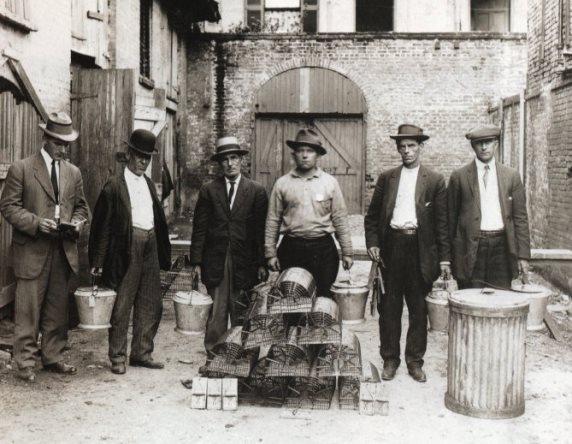
1914, New Orleans. The Public Health Service, created in 1902, helped suppress an outbreak of bubonic plague by mobilizing this team of rat-catchers to eradicate the filthy beasts which spread the disease. Seems like backbreaking work to me, one that would not necessitate a hat and tie.
Per nola.com,
An army of 380 workers swept across the city to carry out the campaign. In a single week, they inspected 6,500 railcars and 4,200 buildings, fumigated 101 ships, trapped 20,000 rodents, laid nearly 300,000 poison baits and discovered 17 infected rats.
Using good scientific protocols, workers recorded data for each trapped rat, and when a laboratory analysis identified an infected specimen, its point of origin was subjected to a scorched-earth campaign of fumigation, burning, and in some cases, complete leveling.. Tactics like these went on daily, citywide, for months.
Ground Zero in the geography of rats proved to be the Stuyvesant Docks, where that first infected specimen had been found two years earlier. Here, mechanical conveyors transferred Midwestern grain among railroad cars, ships and elevators. Coupled with the warm fresh water of the nearby Mississippi River and ample nesting opportunities, the Stuyvesant elevators were a veritable rat nirvana. The campaign made them into a rat graveyard.
Susan Langenhennig, workers preparing rat poison
Death to the Black Death!
Bonus rat fun fact: Cagney never actually said, “You dirty rat.”
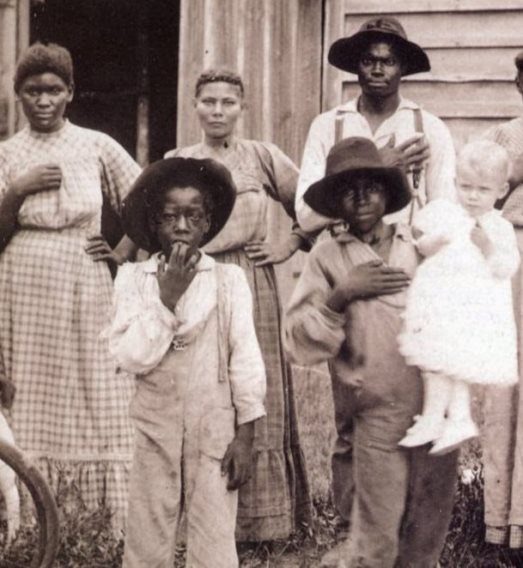
Nope, this isn’t slavery. It’s 1910, nearly half a century after the end of the Civil War, smack dab in the middle of the Jim Crow era (laws enforcing racial segregation in the South between the end of Reconstruction in 1877 and the beginning of the civil rights movement in the 1950s). Though they aren’t physically segregated in this shot (one farmhand even holds the baby), the economic, educational, and emotional implications are there.
This portrait shows a Florida tobacco farmer with his farmhands. I’m not sure as to why most of the farmhands have their hands over their hearts, pledging allegiance style, but you can see that the whole family is included, from the son to the baby to the dog.
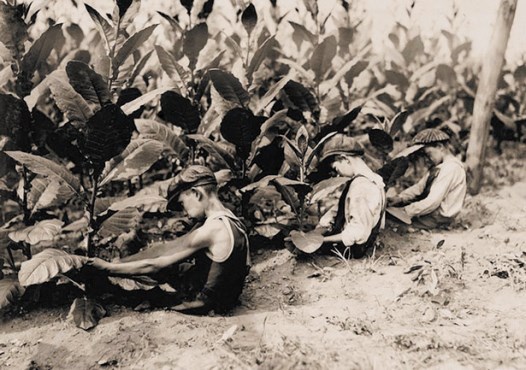
As you can see, tobacco farming doesn’t look too fun.
These children are topping (removing the budding part of the tobacco plant which will, if not removed, flower and produce seeds) and suckering (controlling sucker growth by removing the budding part of the tobacco plant which would otherwise flower and produce seeds) tobacco plants much further north in Buckland, Connecticut, about the same time as the earlier image was taken. Grueling indeed.












 I Don't Get It