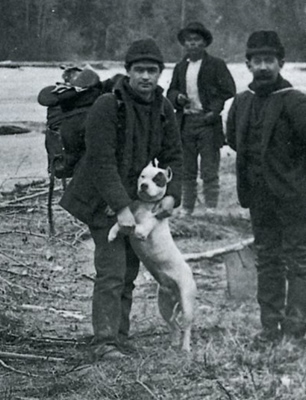
Here a family drags all of its belongings into the Yukon Territory near Alaska in 1898. This must have been the granddad of Petey the dog from Our Gang.
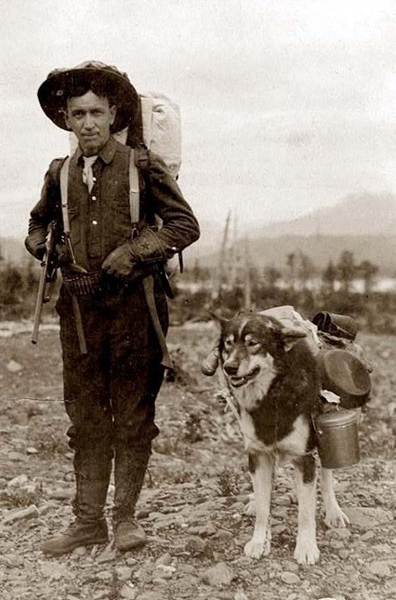
And here’s a happy pack dog with his gold-prospecting owner in the Yukon Territory a few years later. He gets to carry the pots and pans.
pinterest
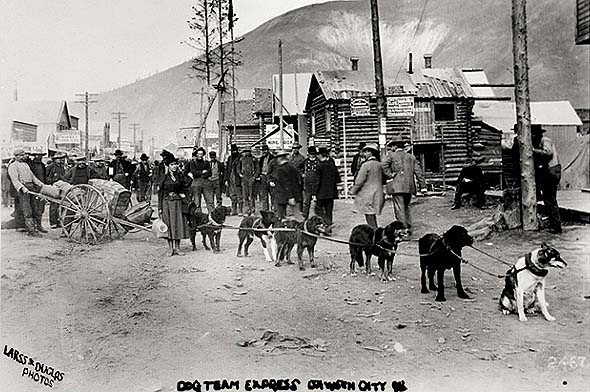
This group of dogs in Dawson City in the Yukon was responsible for carrying mail in 1898.
The stern-faced Miss Florence Stullken looks about as happy teaching typing to her class in 1937 as Miss Bass looked teaching my typing class over 40 years later. I did not like Miss Bass. She was tall and bony and ornery and she knew when you made an error because there was no delete button then, only White-Out, and that was messy. I despised when she taped a sheet of paper over my fingers so I couldn’t look at them, but by golly, I learned to type. And at one point, I was typing 80 wpm. But I haven’t taken a test in years.
My teen thinks he can type correctly; he can hunt and peck. But he (along with the other kids of his generation) never took a typing class. Or a cursive class. In fact, cursive genuinely stumps them. It’s like a foreign language.
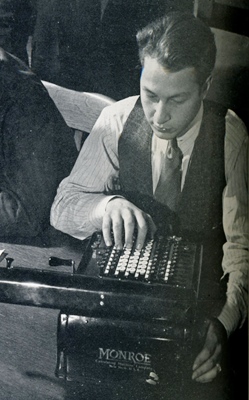
But back in 1937, typing was part of “modern business administration,” as was this nifty machine. The fellow here is compiling and using statistics. For the life of me, I couldn’t tell you what he’s touching, although Monroe made it, and probably not in China.
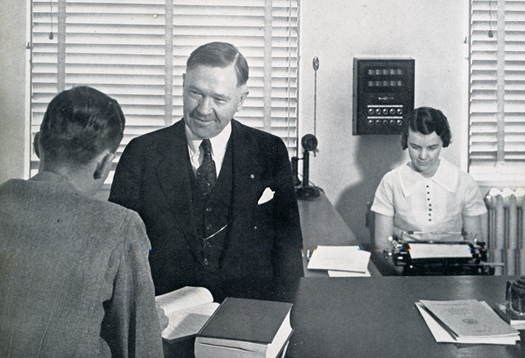
If you learned how to type properly (and your shorthand wasn’t bad), you could score a keen secretary job, like Miss Dorothy Ayres.
Just imagine answering only one telephone line. No monitor to stare at. No basic Freecell or Minesweeper to play during the tedium. Perhaps not even air-conditioning. Ignorant of what was trending because nothing was trending. No rock ‘n’ roll on the radio; she’d be grey-haired by the time rock became popular. It wasn’t until the next year that The Fair Labor Standards Act would even create a national minimum wage. But, hey, she was a woman with a job during The Great Depression, so she was doing pretty well.
And speaking of women doing well, here’s the inventor of Liquid Paper. Remember how it would clump and get sticky and eventually make the paper so wet that a hole would tear through?
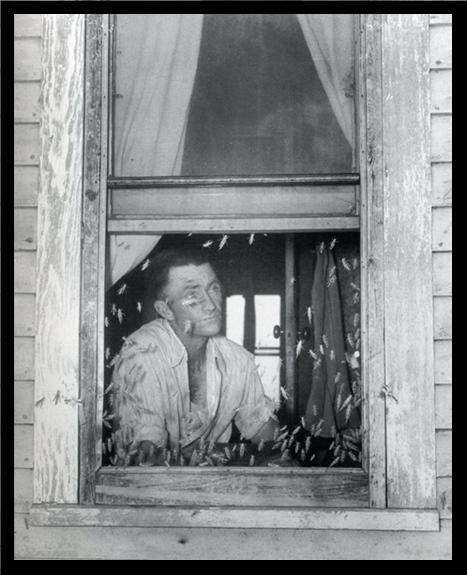
A New Mexico man sits in a stupor, as some of the millions of grasshoppers that invaded the land swarm his window.
Said Sam Arguello of Union County, New Mexico in 1938:
You’d pull on the reins and the horse would slide on the grasshoppers. And that’s a fact. That’s not make-believe. I went through it. I know it.
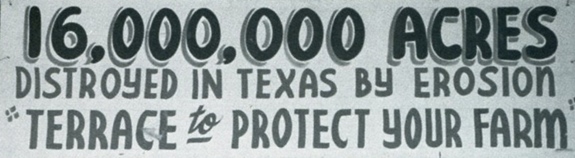
If it wasn’t grasshoppers, it was erosion.
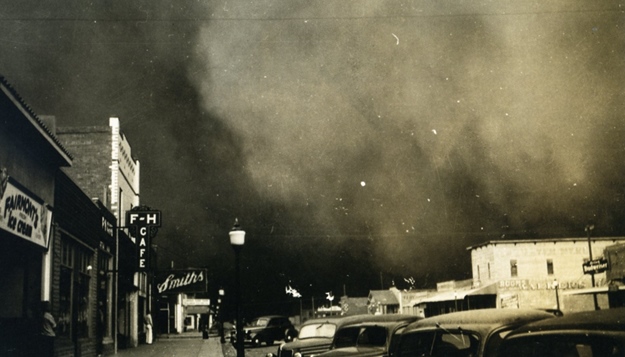
And with erosion, came the dust. Below a black blizzard hits Elkhart, Kansas on May 21, 1937.
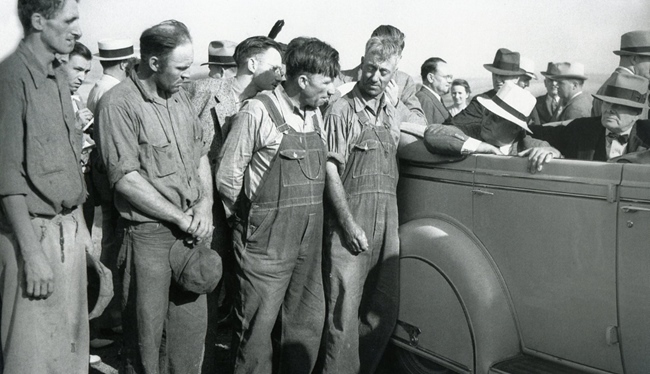
FDR encouraged these Boise City farmers to stay put, offering the promise of help and hope. Said Timothy Egan, “Here’s a land that God Himself seems to have given up on, getting the backhand of nature.”
But many could not heed his words. The Dust Bowl exodus was the largest migration in American history. According to www.pbs.org, by 1940, 2.5 million people had moved out of the Plains states; of those, 200,000 moved to California.
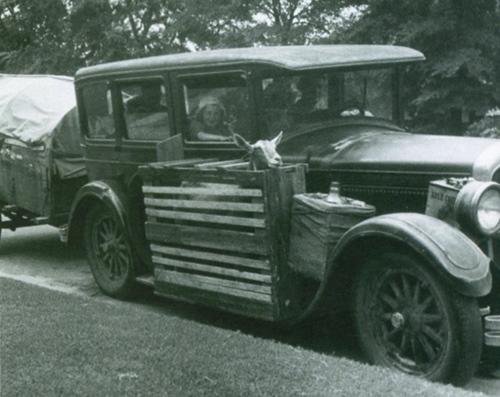
This Texas family loaded up their goat and hit the road, Jack.
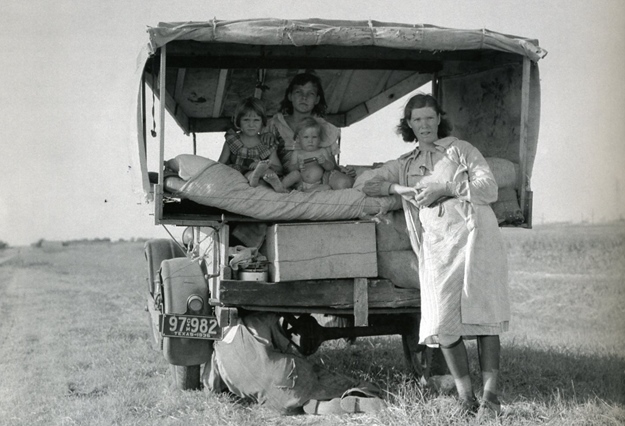
Complications would arise, but this Texan father was able to repair the back axle while his family waited in the shade of a tarp.
Eventually, the drought let up, and precipitation returned. By the end of 1939, the Dust Bowl had shrunk to 1/5 its previous size. By 1940, the drought was officially over, and many farmers harvested their first profitable crop since 1930.
According to Lorene Delay White in The Dust Bowl: An Illustrated History:
Now one will ever know what it meant to us to have it rain. That’s what we prayed for, what we yearned for, was the rain that came that would soak in to the ground and let us raise a crop and eventually stop the dust.
Happy new mama and gruff bodyguard at the Hoopa Indian Reservation in 1896.
For more information on Hoopa peeps, visit https://www.hoopa-nsn.gov/, whose site states: “Serving the people since time immemorial.” That’s a long time.
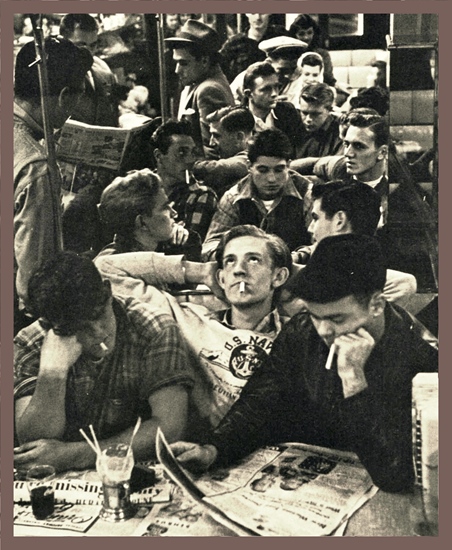
The lucky servicemen who returned home from WWII not in a box often brought home nicotine addictions, PTSD, and not a clue as to where to go from here. Within a year of the end of WWII, six million GIs had drawn an average of two months’ unemployment benefits, calling themselves members of the 52-20 Club, so named for the unemployment pay of $20 for 52 weeks granted discharged servicemen. Rather than quickly return to work, some men (like those in this Long Island soda shop) spent some downtime reading the paper, sipping malts, taking a drag, and sometimes–reassessing.

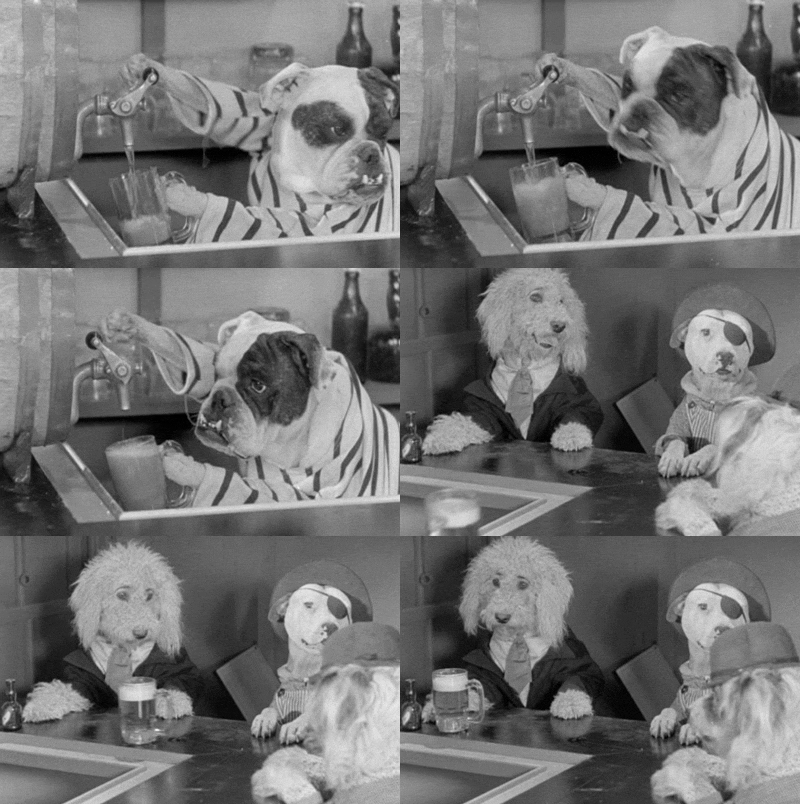

 Yep, that’s




 I Don't Get It