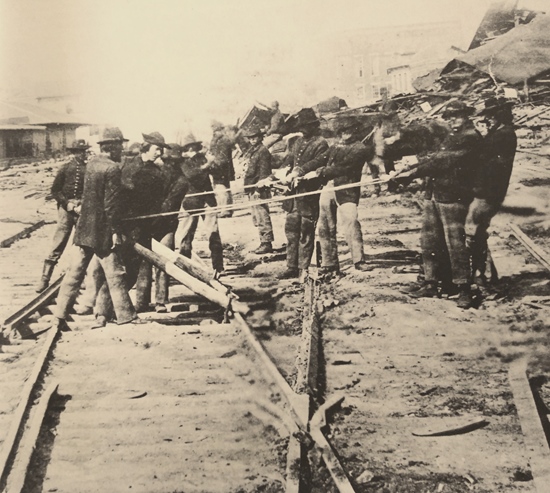
September 1864
General William Tecumseh (arguably the best middle name of all time) Sherman, of the Union Army, has taken Atlanta and orders his men to destroy many of the railroad lines in order to isolate the city from aid.

September 1864
General William Tecumseh (arguably the best middle name of all time) Sherman, of the Union Army, has taken Atlanta and orders his men to destroy many of the railroad lines in order to isolate the city from aid.

Soviet and American soldiers share a dance upon their meet-up at the River Elbe near Torgau. This contact between the Soviets, advancing from the East, and the Americans, advancing from the West, meant that the two powers had effectively cut Germany in two and would be commemorated as “Elbe Day”, the 25th of April 1945. Near Torgau, Saxony, Germany. 26 April 1945.

Wyatt McCain, 8, from North Pole, Alaska, looks upon his father’s grave at the National Cemetery on Memorial Day on May 28, 2012 in Arlington, Virginia. His dad, Army SFC Johnathan McCain, was killed by a roadside bomb in Afghanistan in November 2011.
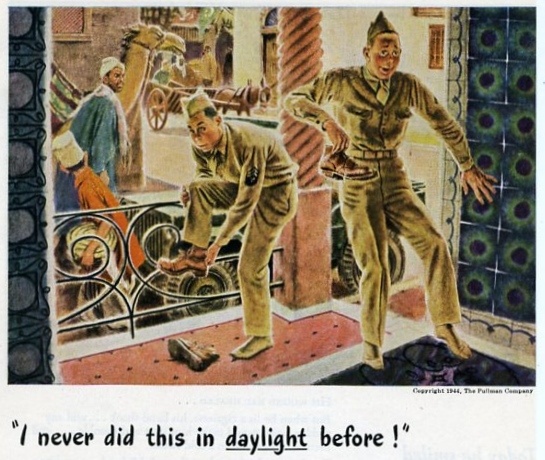

Pullman ad

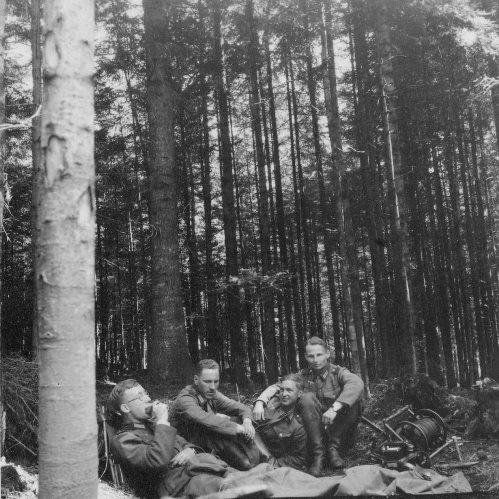
STAFF SERGEANT GEORGE TALBERT OF 3RD BATTALION, 18TH INFANTRY REGIMENT, 1ST INFANTRY DIVISION, ON THE LOOKOUT FOR GERMAN TROOPS IN A FOREST NEAR SOURBRODT, BELGIUM DURING THE BATTLE OF THE BULGE – 19 DECEMBER 1944
Histomil is a great site full of thousands of WWII images, capturing both victorious and horrific moments alike. Some are captioned like the one above, and some leave you with dozens of questions.
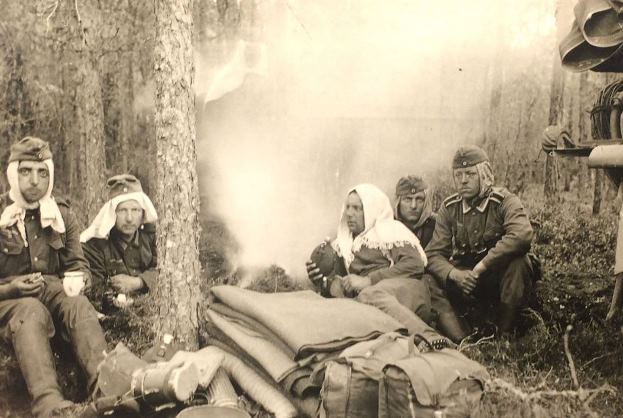

It never ceases to amaze me how low-res and dark a Kodak picture from 1985 can be, and yet this image from a wet plate glass negative by James F. Gibson is clear as a bell. Isn’t it amazing to see this group of fellows at Camp Winfield Scott, near Yorktown, Virginia in May of 1862? It’s from the collection of the Peninsular Campaign, May-August 1862.
This is the full image, but I really enjoy zooming in on the details to get a better understanding of life over 150 years ago.

The sober faces, the wayward hairs, the buttons on their shirts, the metal cup that seems like it would conduct the heat and be hard to handle–so interesting!

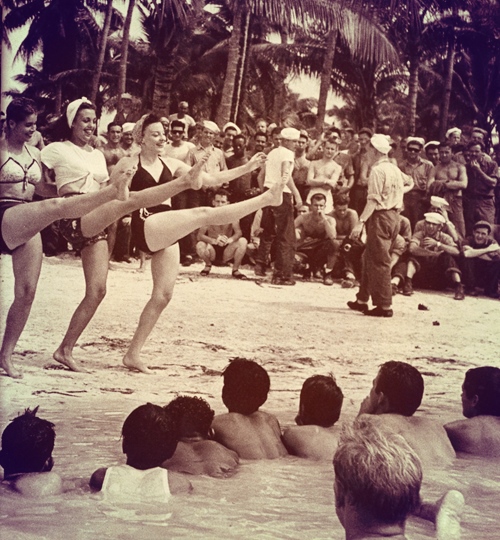
After the victory in WWII, there weren’t enough planes, trains, and ships to carry all the men home as quickly as they would have preferred. Families back home chanted, “Bring the boys home, bring the boys home!” Dozens of USO shows were dispatched to distract the servicemen with bare legs and pretty smiles. It didn’t work. The new chant became, “No boats, no votes!” And with that, Congress brought three million servicemen back home by November. One million were promised to soon be on their way. Sometimes you want eye candy: sometimes you just want to be back in your own warm bed again.
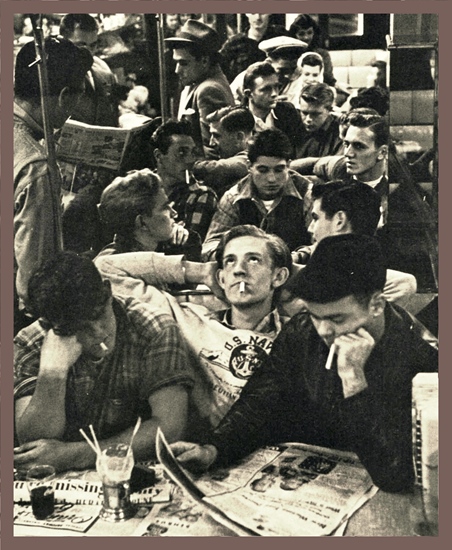
The lucky servicemen who returned home from WWII not in a box often brought home nicotine addictions, PTSD, and not a clue as to where to go from here. Within a year of the end of WWII, six million GIs had drawn an average of two months’ unemployment benefits, calling themselves members of the 52-20 Club, so named for the unemployment pay of $20 for 52 weeks granted discharged servicemen. Rather than quickly return to work, some men (like those in this Long Island soda shop) spent some downtime reading the paper, sipping malts, taking a drag, and sometimes–reassessing.
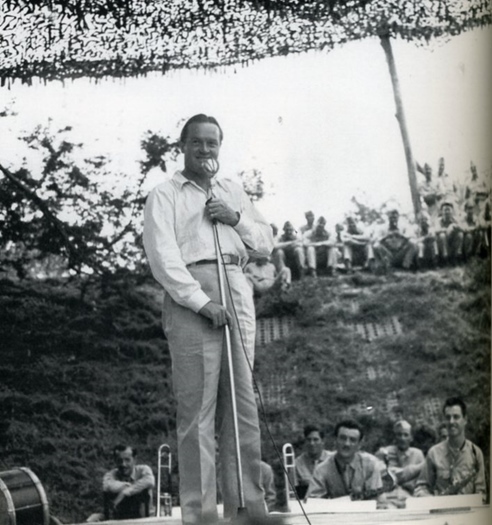
Today we look at the face of the USO, Bob Hope. Back in 1991, on the 50th anniversary of the USO, he penned this letter.
 Well, American soldiers are still in the Middle East, but Bob Hope is no longer with us. However, we shall never forget the years of dedication and contribution that he gave to our men and women of the armed services.
Though his first USO trip was in 1942, his first combat-zone tour was the following year when he visited troops in North Africa. From there, he toured Italy. While in Palermo, the Germans staged an air raid on a target next to his hotel. He realized it was better to bomb on stage than to be bombed from above. General Patton suggested Hope and his group, including Frances Langford and Jerry Colonna, go to Algiers for their own safety.
One of his signature jokes ran, “You remember World War II–it was in all the papers.”
But Hope didn’t quit when WWII was won. In the following decade, he entertained troops in the Korean War.

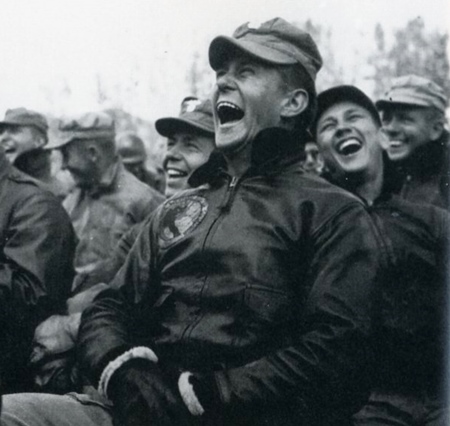
Just check out this soldier’s response to Hope’s performance in Seoul, Korea in October 1950.
But it wasn’t only able-bodied troops he entertained; Hope and his celebrity pals toured hospitals to encourage those who had been injured. He and Marilyn Maxwell spent time with Marine PFC Howard Wells in the Tokyo General Hospital.

As decades passed, Bob Hope specials were a veritable who’s who of stars. But no matter the rise and fall of his cohorts, Hope was the one constant.
With Jerry Colonna as Santa, Hope made fun of his “road to” movies in Vietnam. By then, Hope was such a well-known actor that his familiar presence was a comfort to those who’d grown up watching him.

I recall watching Bob Hope specials as a child, much like the one below from 1983.

Aging didn’t slow Hope down. During the Christmas of 1990, Hope toured the Persian Gulf with his signature stamina. If you recall, this is a man who lived to see his 100th birthday.
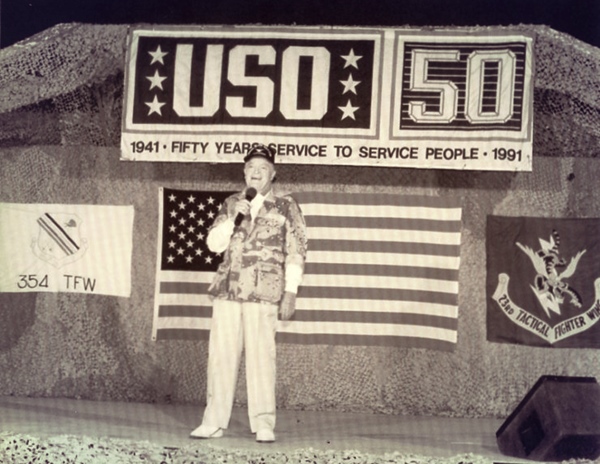
Throughout his 50 years of service, Hope lived up to his name, giving hope to those brave soldiers who fought to keep us free. God bless you, Bob Hope.
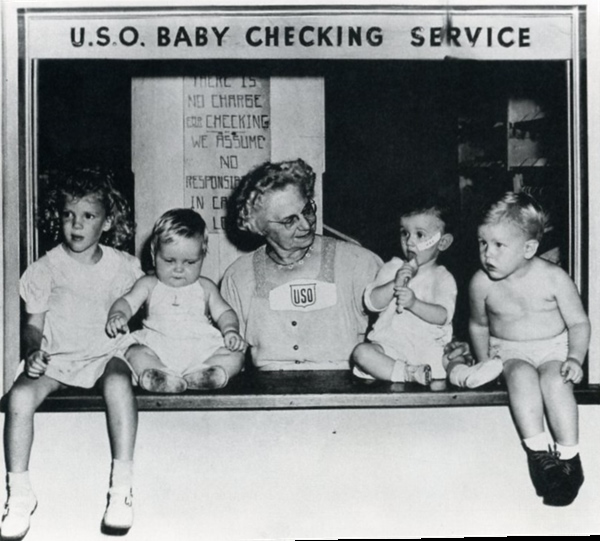
Soldiers on leave could check their children with this woman (at a somewhat precarious-looking early day care) to enjoy a night out with the wife.
Below is the YWCA Honolulu building Service Women’s Lounge for women serving in the war.

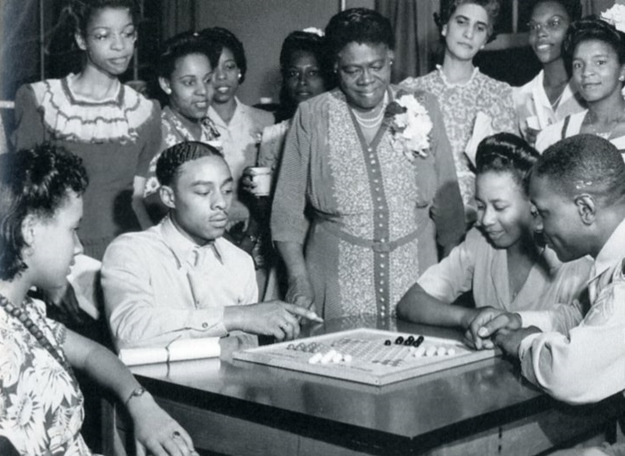
Among these nattily-dressed women is Mary McLeod Bethune, president of the National Council of Negro Women. She is supervising a USO game of Chinese checkers.
Soon, celebrities would begin to entertain the troops. The first was Joe E. Brown, whom you may recall from last month’s post, Ripped At Sixty. He was the first Hollywood star to tour front-line bases, including Alaska and the Aleutians in 1942. Sadly, that same year, his own son was lost when his A-20 Havoc crashed during pilot training.
Here Joe signs a bomb.

Brown was one of only two civilians to be awarded the Bronze Star in WWII. But by far, the name most connected with the USO was Bob Hope, whom we’ll spotlight tomorrow.

With its clubs and other activities, the USO not only served the needs of America’s men and women in uniform, bu also provided an effective means of channeling civilian volunteer efforts. By the war’s end in 1945, over 1.5 million Americans had contributed their time to the USO. — Always Home:50 Years of the USO
It felt good to provide a service to those who served in the war. These Navymen are enjoying coffee and doughnuts at the San Francisco USO.
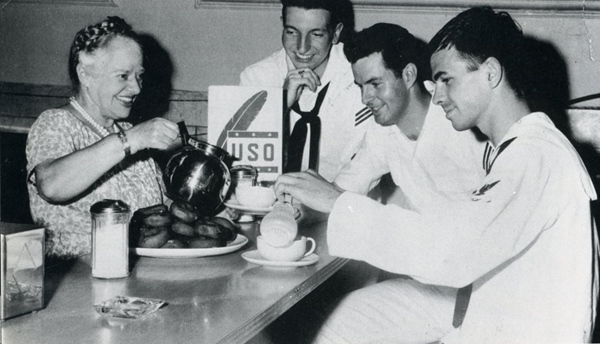
Never underestimate generosity and gratitude.

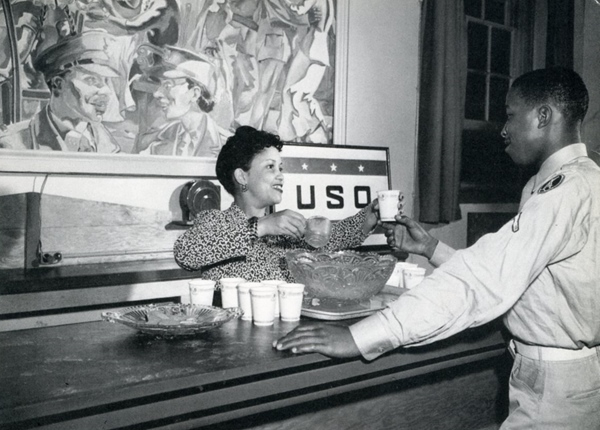
Pictured above, Mrs. Alfred Scott serves punch to a soldier in July 1943 at the Phyllis Wheatley YWCA USO.
The USO (United Service Organization) was formed 75 years ago, in February of 1941, a full ten months before the USA entered WWII. Under the shadow of Nazi aggression, the US government instated the first peacetime draft in its history. Mobilizing thousands of young men, most of whom had never left the country, proved daunting. President Franklin D. Roosevelt wanted a way to keep servicemen in touch with civilian life. Six organizations–the YMCA, the YWCA, National Catholic Community Board, National Jewish Welfare Board, the Travelers’ Aid Association, and Salvation Army–pooled their resources to form the USO.
Roosevelt insisted that these organizations handle the on-leave recreation of these men. On February 4, 1941, the USO was incorporated in New York State. Under the leadership of Chairman Thomas Dewey (yes, THAT Dewey), by the end of the year, they had raised $16 million. In 1942, Dewey ran for governor of New York, and was replaced by Prescott Bush, the father of Bush 41. He contributed greatly to the organization, and soon USO centers dotted the country at bus and railroad terminals as well as training centers.
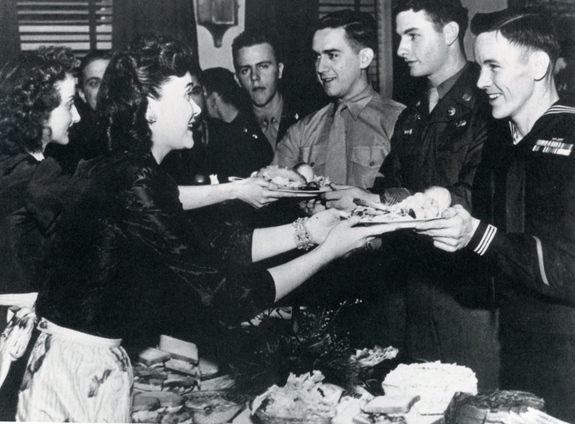
Sometimes a smile and hot meal were enough to make a soldier feel appreciated.
This image from a USO on the French Riviera lists many of the services offered to men in the armed forces.

Stay tuned for the next installment of this USO series. I can’t wait to share the images!
 I Don't Get It