
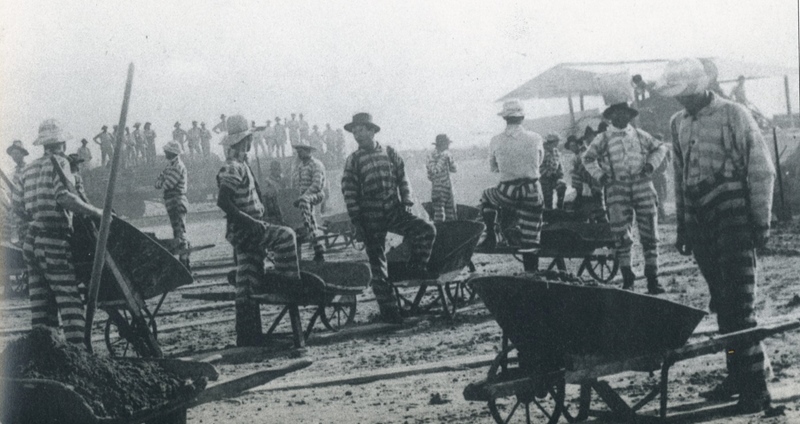
Get a load of Mr. Striped Sassypants, begrudgingly working on a Florida farm in 1910. He should just be glad he wasn’t chained to all the other convicts. Chain gangs, in which convicts were chained and forced into labor, were most popular in the Southern States prior to 1955. But some still exist.

In recent years, Sheriff Joe Arpaio of Maricopa County, Arizona has drawn criticism from human rights groups opposed to punishing criminals by making them work outside in the heat. Arizona’s modern chain gangs, instead of doing unproductive tasks like digging ditches, often do things like removing trash.
During the summer of 2003, when outside temps hit 110 degrees F, Arpaio responded to complaining inmates, “It’s 120 degrees in Iraq, and the soldiers are living in tents, and they didn’t commit any crimes, so shut your mouths.”

On the other hand, states like Ohio allow inmates to use mini-tablet computers to connect with friends and family while incarcerated. I bet that would make prison more enjoyable. And I bet those convicts below would prefer the mini-tablets to the labor.
 I Don't Get It
I don’t know if those guys would like a mini-tablet but I bet they sure could use a mini-fridge stocked with cold beverage.
LikeLiked by 1 person
I’d like that myself.
LikeLiked by 1 person
Prison rules and use of inmates is constantly under review and is manifestly different in different jurisdictions. When I drove tractor-trailer long-haul every province and state had different rules. It was not only possible but likely when you crossed a state line that what was legal is now not legal. Same is true of laws and prisoner treatment. There is an argument to be made that citizens of that state pay for either incarceration or highways, and that how they democratically determine the usage and paradigms has the right to be the laws enforced – by virtue of representation for taxation and majority rules. That said, there is an underlying reality in both cases that is likely always the target – use of highways so they sustain minimal damage and wear for the required use and making inmates contributors to our society by at least contributing work that adds value while reducing recidivism. My personal beliefs are that many prisoners require different treatment depending on personality – they gain and society gains when they are treated individually. For instance the big bruiser would do well on construction crews or the smart weakling would do better planning and in logistics.
LikeLike
That does make sense, but it also sounds like it would take FOREVER to assign them different tasks. We don’t even teach children individually in schools, so that would be difficult to implement. But I agree that contributing to society and doing productive (not menial) work is a good thing.
LikeLiked by 1 person
The whole issue of whether we’re going for punishment or reformation must be clearly resolved before any kind of humane standards can be expected across the board — but people working on chain gangs are treated no better than slaves.
LikeLiked by 1 person